LB City Council Agenda for Tues., Oct. 27, 2026

Below is a summary of what’s on the City Council agenda for this coming Tuesday, October 27, 2026.  In this agenda summary, I cover what I think are the more noteworthy items that will appear on the Council agenda.  If you want to see the entire agenda, click here.   My agenda summary doesn’t include all of the items up for consideration – just ones that I think should have additional community awareness.  Please share this with others if you represent a neighborhood association (thanks for doing that). 

Our meetings generally start at 5:00 p.m. on the 2nd and 4th Tuesdays of the month at Laguna Beach City Hall, 505 Forest Avenue – the meeting is in the Council Chambers adjacent to Fire Station #1. 

There is no study session this week, but like last week, there is an extended closed session. 

The Regular Meeting starts at 5:00 p.m.

I’ll highlight these items on Presentations and on the Consent Calendar:

  • It will be fun to honor Bushard’s Pharmacy’s 80th birthday – what a special place and special family.  And in their most recent year, they had to endure the Promenade’s construction – happy anniversary, Bushard’s!
  • Council will be asked to consider joining the Blue City Network, a recommendation from the Environmental Sustainability Committee (ESC).  More information about what this means is here.
  • An item would approve a contract to do work to maintain the PD’s shooting range behind the Irvine Bowl.
  • There is a complex-sounding but pretty basic item that would make our Muni Code adhere to what Caltrans requires for Caltrans-operated roadways in cities, including how cities can or cannot add infrastructure like parking meters.  This does tangentially relate to our pending action to add paid parking and space demarcations to various locations in South Laguna.

The regular business and public hearings calendars have these items:

  • Something high on everyone’s list – better synchronization of traffic signals through town.  This item specifically authorizes us to submit a regional grant application to OCTA, proposing a project to improve timing across 40 signals on State Routes 1 and 133 at a total cost of about $3.6 million (80% of which is funded by the OCTA grant, 20% from other funds like our gas taxes, or other Measure M funds).
  • Council has understandably asked for more updates and greater transparency about our overall Capital Improvement Plan, and its schedule. This item is the first “quarterly report” of this information – I’d encourage you to take a look at it at your convenience.
  • One item is proposed to be continued to November 10 – that being the approval of Mills Act contracts for two properties (330 Jasmine, 385 Hawthorne).  Remember that the Mills Act is a statewide program that allows cities to cities to incentivize the protection of historic structures through reduced property taxes.  The property taxes saved are supposed to be reinvested (via an approved plan) in the property’s historic preservation.

There are no appeals on Tuesday night’s meeting.  Also, the “Appeals Day” planned for Thursday, November 5th, will not occur – there was only one appeal scheduled, and it made more sense to move that to a normal meeting day.     

Some community notes:

  • Gosh, what a wild few weeks / months with El Nino.  Pick your climate-related event: the PCH crack issue at Crystal Cove, regional coastal erosion / sand movement and loss, swell-related flooding at Main Beach, the King Tides expected between 10/26 and 10/28, and even having to (willingly) send Fire Department personnel and equipment to last weekend’s Norte Fire.  We’re also working on a challenging issue up on Skyline above Canyon Acres – we’ve worked for an extensive period on a nuisance abatement involving a slope failure that involves private property.  If the area is not winterized rapidly and abated properly (notices went out today), we will seek to do the work ourselves.   Remember to check out our El Nino preparedness page, including two planned preparedness events (November 9 and December 1) – use that page to sign up for the events.  The November 9 one will also be livestreamed and recorded. 
  • The El Morro Boo Blast has a new location – Thurston Elementary – because of the ongoing PCH / Caltrans work.
  • Concerts in the Canyon via the Coast Film Festival are this weekend – seems like they will all avoid the wet weather (which has been a nice dampener for at least a bit on fire season).
  • The Promenade’s remaining work gets smaller and smaller.  They’re done with the Forest / Glenneyre section, and now focusing on interior additions (where backordered framing parts come in, we can brick those areas out), as well as the last major piece of the puzzle – the Coast Highway / Promenade side.

$100,000 Walks Into a Laguna Election

Courtesy of NimbleGov.org


Laguna caps donations at $500. One company put $100,000 behind three incumbents, and nearly all of it has now been spent.

Dear Readers,
For more than a year we have argued that Laguna Beach elections are not a level playing field. Incumbents run with name recognition and a donor network built over years in office. That money gap is a strong reason we need term limits.

The latest campaign reports show how wide the gap has become.

The Gap Is Nearly Four to One
The candidates’ Form 460 reports, current through October 19, show:
• The three incumbents, Mark Orgill, Sue Kempf and Alex Rounaghi, have taken in $168,262 this year.
• The four challengers who filed full reports have taken in $72,193 combined. (Both totals include loans.)
• Alex Rounaghi alone has raised $78,484, more than all four challengers together.
•
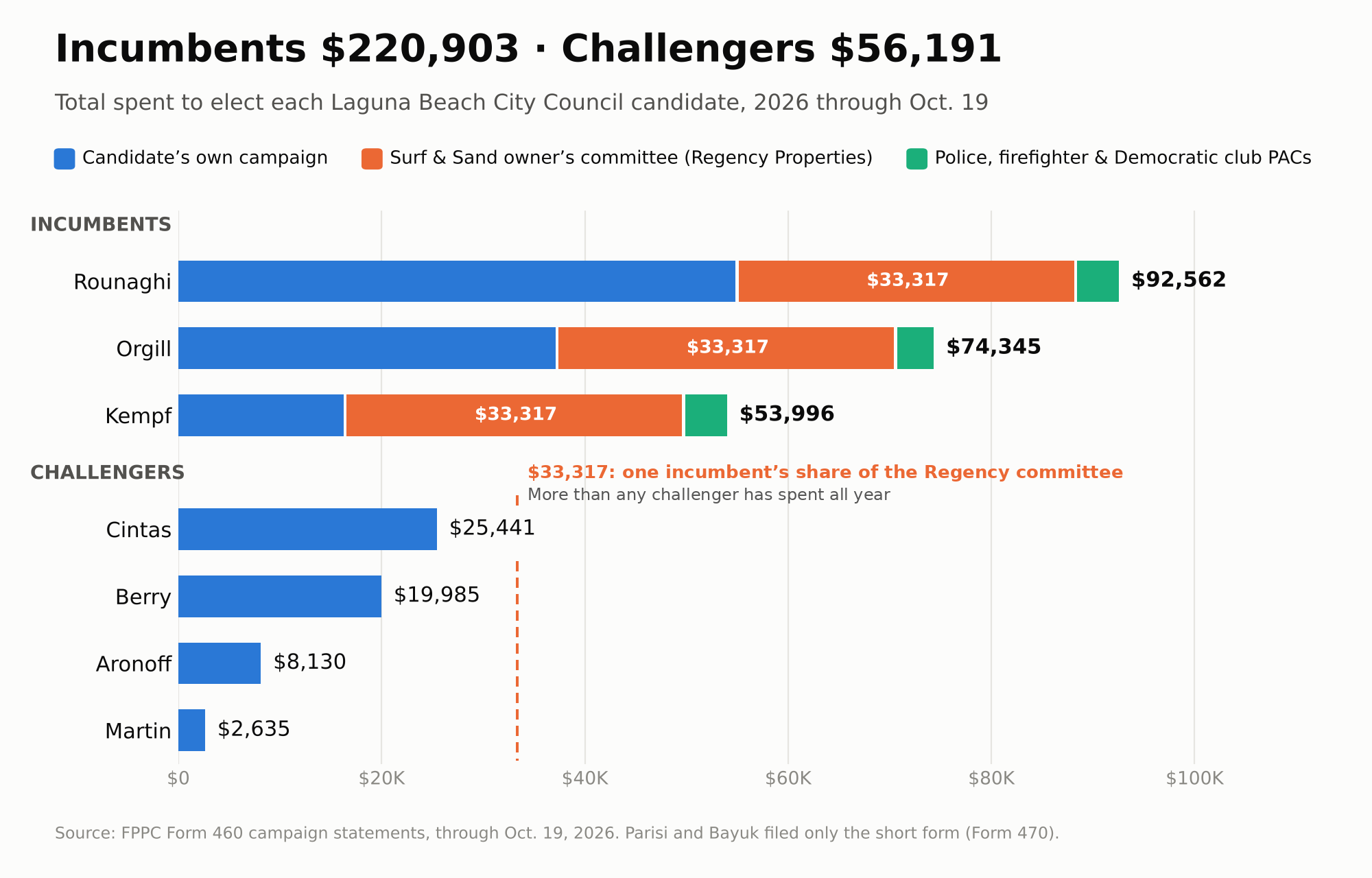
Add the outside money, and about $220,900 has been spent to elect the incumbents, nearly four times the $56,191 the challengers have spent.

$100,000 From a Single Company
On October 1, a new committee reported its first contribution. Its full name says it all: the Laguna Beach Good Leadership Committee Supporting Kempf, Rounaghi and Orgill for City Council 2026, Sponsored by Regency Properties LP and Affiliated Entities (FPPC ID 1497439).

Its Form 497 shows a single contribution of $100,000, received September 30 from Regency Properties, L.P., and affiliated entities, owner of the Surf & Sand Resort.

The committee’s Form 497, received by the City Clerk on October 1, 2026, showing the $100,000 contribution from Regency Properties, L.P. Source: City of Laguna Beach campaign disclosure records.

Since then, the committee has spent $99,950 of it, split almost to the penny: $33,316.67 for Rounaghi, $33,316.68 for Kempf and $33,316.65 for Orgill. That is more, per incumbent, than any challenger has spent all year. Police, firefighter and Democratic club PACs added up to about $4,100 more for each incumbent. No outside group has spent anything for a challenger.

The mailers are arriving. When they do, check who paid for them.

How is this possible under a $500 limit? The limit covers only candidates’ own campaigns. Under Citizens United, an independent committee can raise and spend unlimited amounts if it does not coordinate with the candidates. I am not alleging anyone broke that rule. But one large donor can still drown out hundreds of residents giving $100 or $250.

Same Donors, Two Campaigns
The incumbents’ support is also tied to the campaign against term limits. Several donors who gave to all three incumbents also gave to Citizens for Laguna’s Future, the committee formed to defeat Measure E.

No sitting councilmember supports term limits; every challenger at the Village Laguna forum did.

The network funding the incumbents is also funding the effort to keep them in office, and one company has now added six figures.

“Just Vote Them Out” Meets a War Chest
Opponents of term limits say, “If you don’t like them, just vote them out.” That only works on a level field. When incumbents outraise challengers better than two to one and one company spends nearly $100,000 more, a newcomer is running against a war chest. See James Danziger’s case for term limits: https://georgeweiss.substack.com/p/why-i-will-vote-yes-on-term-limits

Measure E does not ban anyone from serving. It allows two consecutive four-year terms, then a two-year break, after which a former member may run again. The break creates open seats where residents compete on ideas instead of money. Twenty-eight of Orange County’s 34 cities have term limits.

Follow the Money Before You Vote
Money only works if voters don’t know where it comes from. The best defense we have is sunlight.

• Look at the filings yourself. They are public records available from the City Clerk.
• When a glossy mailer arrives, check the “paid for by” line. Ask who is behind that committee and what they want from City Hall.
• Forward this Email to every Laguna Beach voter you know.
• Vote yes on Measure E and no to candidates that do not support it.
• Election Day is November 3, and many neighbors are voting now.

Thank you for reading, and vote for candidates that support term limits.

NimbleGov Team

What’s on the LB Council Agenda for Tues., Oct. 13, 2026

Below is a summary of what’s on the City Council agenda for this coming Tuesday, October 13, 2026.  In this agenda summary, I cover what I think are the more noteworthy items that will appear on the Council agenda.  If you want to see the entire agenda, click here.   My agenda summary doesn’t include all of the items up for consideration – just ones that I think should have additional community awareness.  Please share this with others if you represent a neighborhood association (thanks!).

Our meetings generally start at 5:00 p.m. on the 2nd and 4th Tuesdays of the month at Laguna Beach City Hall, 505 Forest Avenue – the meeting is in the Council Chambers adjacent to Fire Station #1. 

There is no study session this week, but there is an extended closed session.  

This meeting, then, starts at 5:00 p.m.

I’ll highlight these items on the Consent Calendar:

  • Dedication of the soon-to-be-restored Seagrave Fire Engine (dating to 1931) for retired captain Eugene “Diz” D’Isabella – Diz and family and friends may be present for the dedication, so this should be a nice presentation.  The Seagrave itself is not yet restored, but it’s coming along.  Our thanks to all who donated to its restoration and to those who encouraged the restoration.
  • An item about changing Title 18 of our code (which relates to beaches and parks) to require certain safety equipment (like helmets, knee and elbow pads) at the skate park and related facilities. 
  • An item that appropriates funds from the Wildfire Mitigation and Fire Safety allocations for a couple of things, as recommended by the City’s ad hoc committee on fire safety (Kempf and Whalen) – improved extrication equipment to ensure we can safely get folks out of newer, stronger cars; software and shelter supplies for the EOC and disasters; and an assignment of funds for longer maintenance of the outdoor warning system.

That’s what’s on the consent calendar.  The regular business calendar has these items:

  • An appropriation from the Disaster Contingency Reserve for consultant services relating to keeping an ER/Emergency Department in South Laguna.  This follows an RFQ process for consultant services that didn’t get a lot of responses, though a lot of firms looked at it.  Since then, the City Attorney and I have worked with the ad hoc committee to revisit the needs, with a focus on legal and regulatory issues.  As such, the item sets aside up to $500K for special services that will assist the City in keeping hospital services in town.  I am recommending use of the Disaster Contingency because the closure issue has life-safety implications – and it also provides smart direction to restore the amount reduced to the Reserve over up to 3 budget cycles.  This agenda item also includes a letter that Council Members Rounaghi and Whalen sent to the CA Attorney General in late September. 
  • A study session-ish item about the right surface material if we are to repair the Boardwalk at Main Beach.  The Planning Commission suggested Douglas Fir, which is fine, but we felt it important to have more awareness of the issue and some Council input before going forward with additional design work.  No changes are proposed for the width, length, curvature, or nature of the Boardwalk – just a discussion of the best surface material. 
  • We’re returning to the Council with an item to in part meet the State’s EV mandates for municipal vehicles – this is the infrastructure / charging station side of that, and includes off-setting rebates and a cost-benefit analysis done by a 3rd party.
  • There’s a ratification of yet another Declaration of Local Emergency, which I made today due to impacts starting yesterday of the remnants of Hurricane Rachel.  The State – through CalOES – asks that we declare separate emergencies for each storm by name.  A bit frustrating. 

There are no appeals on Tuesday night’s meeting.  We did hear word today (Friday) that Pacific Edge has withdrawn its application to place construction worker parking in the lot near Laguna Terrace, due in large part to community concerns from Laguna Terrace residents.  Therefore, an appeal of the Planning Commission’s approval of that application – tentatively set for November 5, 2026 – will not be necessary.  Pacific Edge told us in the letter that it will seek out other options.   

A couple of community notes:

  • I sent out an email earlier today (Friday) about Hurricane Rachel issues and preparations.  Speaking of that, we have an El Nino Preparedness Page and a Workshop scheduled for Monday, October 12, 2026 – information is here.   Suffice it to say that this has been a rough year, and staying ahead of the weather and climate change hasn’t been easy or simple. With that earthquake in Panama this morning, I was curious as to what else could befall us.  I’ll go over more of what we’ve been working on re: El Nino preparedness during my always-scintillating City Manager’s comments on Tuesday night. 
  • The current work on the Promenade includes finishing up the new crosswalk texture (brick) at Forest and Glenneyre – I know that this is a hassle, but most of the work is night work.  Today, as the contractor was buttoning up the location in the a.m., the timing was such that the flooding on Coast Highway was also hitting.  Let me apologize for that for anyone stuck in traffic – we’ve already moved to adjust that timing.  And there’s not much more work to be done. Also, a few more grates trickle in from backorder, and those are installed as they come in (with the commensurate removal of some of the more dusty DG).  We’re still struggling getting permits off of desks at Caltrans (for the PCH side), and awaiting full power that would allow the fountain to operate (and more lighting).  Argh.

As always, thanks for reading this far.

The Weiss Report Voter Guide for City Council

Courtesy of The Weiss Report
*Views Expressed in this article are of the source and not completely the views of LBChat.com.

Three seats, three candidates, and why none of the incumbents should get your vote.

Dear Readers,

Mail-in ballots are arriving. Nine candidates are running for three City Council seats, including all three incumbents: Mayor Mark Orgill, Sue Kempf and Alex Rounaghi.

I have attended the first three major forums and reviewed the transcripts. Village Laguna’s on August 31, the Greater Laguna Beach GOPs on September 23, and the Laguna Canyon Conservancy’s on September 28. See my Substack archive for my reporting on them. I have also gone through the candidates’ statements and websites, and I have looked at the incumbents’ records, much of it from the dais beside them. I am supporting Joy Berry, Laura Parisi and Ashley Cintas.

Here is Why: They are three different people with divergent backgrounds, and they don’t agree on everything. You will see that below. But each of them answered the question that matters: when residents and City Hall want different things, who will you serve?

Where do they stand together

Across three forums, these three were consistent on the issues residents raise most often:

· Term limits. All three support Measure E.

· Spending before taxes. All three named outside consultants as a first cut. All three oppose a sales tax increase, a tax on restaurant and bar customers, and a business license tax on gross receipts.

· No to taxpayer-built parking structures downtown, behind the police station, or on the library site.

· No general fund money to build housing. All three said the City’s assistance for the Neighborhood Congregational Church project went beyond what was needed. They also said the City should be clear about what the state actually requires versus what is a Council policy choice.

· Openness. All three would release the Downtown Specific Plan environmental report and require staff reports to present options rather than a single recommendation.

· Open space. All three oppose glyphosate in our open spaces and support permanently protecting the City’s 2,000-plus acres of open space by enrolling them in the Nature Reserve of Orange County.

· Fewer 5-0 votes. Each said the Council needs members willing to ask tough questions in public and vote no when they disagree.

Joy Berry: the rules apply to everyone

Joy has lived in Laguna for almost 30 years. She was a hotel development manager for Marriott, where she says she built about 40 hotels from the ground up, and she worked on the Montage Laguna Beach project. She later became chief operating officer of a global hotel sales company. She now runs a small lodging business in Carmel. She founded the Laguna Beach Coalition for Environmental Protection and was vice president of Village Laguna.

Her campaign rests on one idea: “one set of rules that apply to everyone, no matter who you know or how much money you have.” She has acted on it. When the Council approved a home on a hillside steeper than the General Plan’s 45% limit, her coalition sued, and the trial court agreed with them. The City has appealed. Her concern is the precedent: if the City can measure a slope from side to side instead of top to bottom, every hillside in town becomes buildable.

She is the sharpest critic of the City marketing to more visitors. She would redirect hotel-tax revenue to public safety, trash pickup, and enforcement. Most of that revenue goes into the General Fund to be spent, however the Council decides. She also wants Laguna to join with other coastal cities in pressing Sacramento and the Coastal Commission. Her developer’s eye for detail came through on two issues:

· Promenade bids. She said any contractor prices projects line by line, and the City should have done the same due diligence.

· The $8 million land trust loan. “In the real world, you get a deed of trust when you loan money.” The City may hold one, but she said it doesn’t appear in the public record, and residents were never shown how $8 million of their money is secured.

Joy brings something the Council lacks: someone who understands development from the inside and will not be talked into exceptions.

Caveat: One can reason that ANYONE with a developer background should not be on the City Council. That’s a reasonable view, but in Joy’s case I believe she will always put residents first.

Laura Parisi: the financial expert who has been shut out

Laura has been our elected City Treasurer since 1999 and is a CPA. Her career began at a large Chicago accounting firm. She sponsored SB 742, state legislation on transparency in city accounting, which is now law.

She is not running because she is tired of being Treasurer. She is running because, in her words, the Council and management have made it “increasingly difficult” to do the job voters elected her to do. This summer she found that County payments for assessment-district bonds had been received but did not appear in the City’s cash records. She reported it in writing in July and again in August. She says she still has not received an answer.

Her priorities are what you would expect from someone who has watched the City’s books for 27 years:

· Monthly revenue and expense reports to the Council.

· A professional audit committee.

· Staffing based on department audits and results.

· No new taxes or bonds to cover operating deficits.

· Safety and infrastructure first.

On contracts, she would start at the request for proposals, requiring line items to be broken out so the public can understand them. City cash and investments fell from $165 million in July 2025 to $146.6 million in July 2026. Laura is the best candidate to tell us why.

Full disclosure: I endorsed Laura earlier this year, we desperately need someone with her financial skills.

Caveat: Despite sitting in on City Council meetings for 25 plus years, she doesn’t seem to have a solid grasp of many other issues. However she is bright enough to master this shortcoming quickly, and I believe will put residents first.

Ashley Cintas: plans, timelines, and results

Ashley owns Oto Sushi downtown, which employs more than 40 people. She is a UCLA graduate and a serial entrepreneur: she co-founded a consumer-products company with her twin sister and later founded City Shoppe, an online marketplace for independent retailers. Before that, she spent years in hospitality management, including work with Ace Hotel brands across the country.

Her message is accountability. At every forum she asked the same questions of every project: What’s the plan? Who owns it? When will it be done? What does it cost? And did it work? She calls the current Council reactive, and she wants:

· Monthly budget-to-actual reports.

· A 5-, 10- and 15-year funding plan for pensions, South Laguna, insurance, and capital projects.

· A real-world stress test of our wildfire evacuation plans before a crisis finds bottlenecks for us.

As a downtown business owner, she has a practical answer to the City’s revenue problem: fill our empty storefronts before asking residents to pay more. Speeding up permitting and design review would help. On tourism, she wants current data, noting the City still relies on numbers that are about 20 years old. With that data, she would pursue longer-staying visitors rather than more day-trippers. And on the land trust loan, she was blunt: it was “not fiscally responsible.”

Readers should know that Ashley sits on the board of Visit Laguna Beach, the tourism marketing organization. She has not hidden from the issue. At the GOP forum she said she does not approve of the Council’s 10-year, non-cancelable agreement with Visit Laguna, and her approach to tourism is about measuring the cost to residents, not attracting more visitors. Still, I have criticized Mayor Orgill for sitting on Visit Laguna’s board while voting on its contract, and I hold Ashley to the same standard. If she is elected, she should step off the board or recuse herself on Visit Laguna matters, and I have asked her to say so publicly.

Ashley is newer to Laguna than the others, and she says so. What she brings is the operating discipline of someone who has to make payroll every two weeks.

Caveat: As a business owner and a board member of Visit Laguna will this candidate do what’s best for the residents of Laguna Beach, or will she be “business first.” Can she balance the two? I think she can.

Where they differ

These three are not a slate that votes in lockstep, and that is the point. A few honest differences:

· St. Catherine’s. Laura and Ashley want the community center residents were promised when the City paid $23 million for it. Joy would ask the private sector for proposals rather than let it sit underused at taxpayer expense.

· The marine protected area. Joy and Ashley support extending the no-take zone to the city limits. Laura thinks the current one is doing its job.

· The Promenade. Joy would not have built it. Laura and Ashley liked the idea but not the planning, the budget, or the result.

Three independent voices who sometimes disagree is exactly what a 5-0 Council needs.

No to the Incumbents: They have driven our city into a financial ditch, so it makes sense to hire new drivers.

I served with all three incumbents, and I respect the hours the job takes. They deserve credit for fire preparedness, where the City has invested well.

But a Council is judged by how it handles money, how it makes decisions, and to whom it listens. On all three, the record of the past four years is the strongest argument for change. They have driven our city into a financial ditch so let’s hire new drivers.

The budget is balanced on paper only. For three straight years, the Council has balanced the General Fund by moving money out of the Capital Improvement Fund, which is meant for fire stations, City Hall, parks, and beach accessways. The transfers were $2.86 million in FY 2024-25, about $1.7 million in FY 2025-26 and $2.29 million this year. This year’s budget moves $7.19 million out of that fund in all, including $3.6 million to cover a deficit in the insurance and benefits fund. The City’s own forecast shows operating deficits returning in FY 2027-28, and the unfunded pension liability grew from about $52 million in 2021 to about $96 million in 2025. All three incumbents voted for these budgets.

The big decisions are made out of public view. Again and again, two-member committees shaped major projects in private and brought finished plans to the full Council:

· The Promenade: Orgill and Kempf. Midnight tree removals didn’t sit well with the public and by most measures the design of the Promenade does not reflect the spirit of Laguna. (and then there’s the statuary, by a non-Laguna artist)

· The artists’ land trust: Rounaghi and Orgill. Its $8 million loan came out of the Vehicle Replacement Fund, the account that replaces police cars and fire engines.

· Taking over Laguna Canyon Road: Rounaghi and Bob Whalen. After spending over 4 million since 2012 the LCR undergrounding project has made little progress.

· The $84.9 million parking plan: Kempf and Whalen. The plan included a taxpayer-funded structure on church property.

· Climate Action and Sustainability Plan: In 2021 the Council unanimously approved the adoption of a plan at the cost of 400 thousand dollars.

· Main Library Should be a Parking Structure: Sue Kempf – Sue denies this, but the overwhelming evidence points to an effort to move the library to make way for a parking structure.

The City’s own news release says the 10-year Visit Laguna agreement was “crafted and negotiated in large part through the efforts of” Orgill, who sits on Visit Laguna’s board. It has no termination clause for non-performance. On September 22, eighteen days after the firefighters’ union endorsed all three incumbents, they approved a new police contract on the consent calendar, 5-0 and without discussion. Staff said some of its terms “could not be fully costed.”

The Promenade is the pattern in one project. Residents were told it would cost about $2.8 million. The night the Council approved a $7.2 million budget, it moved $4.4 million from other capital projects to pay for it. No council member questioned the bid’s $10,000-per-chair line item before voting. That same night, the Council turned down 873 residents who had petitioned for an alternative plan. Kempf now says the project is $500,000 under budget, a figure that counts only the construction contract and its contingency.

Residents are left out.

· Eagle Rock Way. Mayor Orgill called up a disputed South Laguna variance for Council review, which told neighbors they would get a hearing. On September 22, he withdrew it before the hearing began, after the deadline for residents to file their own appeal had passed.

· The Nature Reserve study. In 2023 the Council voted to study enrolling our open space in the Nature Reserve. Nothing came back for 32 months, and the findings are now scheduled for December 8, a month after the election.

· The Dupuis investigation report. In November 2023, Kempf and Rounaghi joined Whalen in a 3-2 vote to keep it from the public, after residents had paid roughly $450,000 for the former City Manager’s severance settlement.

· The Blue Cottage. In July 2025, Kempf and Rounaghi voted to let a 1914 cottage be demolished for seven parking spaces.

Election-year conversions. At the GOP forum, all three incumbents said they now oppose spending $141 million to underground Laguna Canyon Road, after pursuing it for years. They also distanced themselves from height increases in the Downtown Specific Plan they championed, and from the façade grants they approved last year. At its June study session, the Council directed staff to draft a business license tax focused on bars and restaurants. Asked about the $13 million church parking structure, Kempf said, “I don’t even remember the vote.” Asked whether the City holds a deed of trust on its $8 million land trust loan, Rounaghi said he didn’t have the answer. Orgill said, “I thought we did.” All incumbents oppose term limits on the ballot as Measure E.

The pattern shows a Council that answers first to City Hall and its allies, and to residents mainly in election years.

Question for voters

The incumbents have spent this campaign saying the right things about consultants, staffing, taxes and listening. Much of it is new, and it arrived in an election year. You can decide for yourself whether that is a change of heart or a change of season.

I am voting for Joy Berry, Laura Parisi and Ashley Cintas. I am also voting yes on Measure E.

Thank you for reading, and as always, I welcome your thoughts and any corrections.

George Weiss

Sources: Village Laguna City Council candidates forum, Aug. 31, 2026; Greater Laguna Beach GOP City Council candidates forum, Sept. 23, 2026 (Parts 1 and 2); Laguna Canyon Conservancy candidates forum, Sept. 28, 2026; official candidate statements, City of Laguna Beach, November 3, 2026 General Municipal Election; joy4laguna.com; ashleyforlaguna.com; Daily Bruin, “UCLA grad solves yoga dilemma with her business,” Jan. 30, 2014; Best of Laguna Beach, “New OTO Sushi to open late October,” Sept. 17, 2024; City Treasurer’s monthly reports, July 2025 and July 2026; City of Laguna Beach FY 2026-27 Adopted Budget; City Council staff reports, Dec. 9, 2025 and Jan. 27, 2026 (Community Land Trust loan); City of Laguna Beach news release on the Visit Laguna Beach agreement, November 2024; City Council Minutes Recap, Sept. 22, 2026 (police contract; Eagle Rock Way call-up); City Council meeting recap, Nov. 21, 2023, Item 10, and staff report, Aug. 4, 2026, Item 13; City Council meeting, Jan. 13, 2026 (Promenade contract award); City Council study session, June 9, 2026; Voice of OC, “Laguna Beach Keeps Hostile Workplace Investigation Secret,” November 2023; Laguna Beach Coalition for Environmental Protection (lbcep.com). Earlier posts on this Substack: “Four Promises, One Pattern,” “An Appeal With No Hearing,” “What the Incumbents Told the Canyon Forum,” “Across the Table,” and “Whom Do They Serve?”

The Mayor Who Forgot What He Said

Courtesy of The Weiss Report

He argued for a 10-year deal, then said he pushed for five. He proposed “multi stories” downtown, then called it disinformation.

I asked Claude Ai to compile statements made by the Incumbents at City Council meetings during the last few years of service. The report has over 1,000 entries. I’d describe them as a sample of what the incumbents said on the record, chosen to show patterns, and not as a list of their worst moments.

That what the picks actually are. Some are flat contradictions. Others are remarks that show how a member thinks about residents, money or accountability. A few are simply odd things to say from the dais, in their own words. Take a look at the video links and see for yourself.

Every quote below comes from the City’s own meeting videos. Each “Watch” link opens the video at the moment the statement was made, so you can hear it for yourself.

Term Limits: Good for Sacramento, Not for Laguna

Fine for Washington and Sacramento, but not for Laguna.

At the Advocates for Laguna Residents forum (September 15 2026), asked about Measure E, he said: “I support term limits nationally and for the state, but I don’t really see it necessary for the community.” Asked why, he pointed to the money from super PACs at the state and national level, and said “I’m not raising all that much money.”

The record says otherwise. On September 30, the owner of the Surf & Sand gave $100,000 to a committee backing Orgill, Kempf and Rounaghi together. That is exactly the kind of outside money he says makes term limits necessary everywhere else. He also received $5,000 from 15 donors outside Laguna Beach. That’s about 18% of the $28,400 in itemized contributions.

Note: As the Founder of Visit Laguna Orgill has established a good working relationship with the Surf and Sand. He met with executives of the MOM Group there just days after recieving a large check and hired their GM to serve as the head of Visit Laguna.

What He Said, and What the Record Shows

1. Contradiction: “I pushed for a five-year term.”

Oct. 28, 2025: “I pushed for a five-year term in June. The council majority decided to go with the 10.”

At the June 10, 2025 meeting he argued for the 10-year term: “the 10 years is because there’s artist housing issues.” Answering Whalen’s concern about a long commitment, he said: “I used to own a lot of commercial real estate and I did 20-year leases all day long.”

Watch: June 10 · Watch: June 10, leases · Watch: Oct. 28

2. Contradiction: “No plan for a third story downtown.”

April 28, 2026: He complained of “disinformation” and “vileness” online, and per the record’s summary told residents there is no plan for a third story downtown, only an EIR.

Dec. 12, 2023, when Phase II began: “I think that we should probably consider multi stories throughout the downtown.”

Watch: April 2026 · Watch: Dec. 2023

3. Left residents out of the Promenade focus groups.

April 23, 2024, after you pressed him: “I’ve errored… I did not have intentions to mislead the public and I apologize if there was any misperception.” He blamed his private-sector habits.

Watch the clip

4. Measure height from the flood plain, not the ground.

Oct. 28, 2025: “it might be worth looking at measuring the height from the flood plane, the 100-year flood plane.” In the Arts District floodplain, that means taller buildings at the mouth of the canyon. He raised the same idea in December 2023.

Watch the clip

5. The Dupuis settlement as a business decision.

Nov. 7, 2023: “mine was simple and it was really based on my life’s experience being in business, it was financial… I just truly thought that it would be best for the city to cut bait and move forward.” This was about roughly $440,000 in public money and a report the public never saw.

Watch the clip

6. A $30 million figure with no source.

June 9, 2026: “$30 million is probably coming out of our budget that is directly related to day trippers.” He gave no source, and “probably” is doing a lot of work.

Watch the clip

7. Blaming COVID for the Promenade’s retail problems.

Feb. 4, 2025: “we’re making assumptions that the drop in retail sales is a direct result of the promenade, but what’s affected retail more than anything is just the fact that we went through COVID.” By then COVID had been over for some time, and merchants were still complaining.

Watch the clip

8. “Nefarious accusations.”

April 28, 2026, closing the city charter hearing: “I get a little bit disappointed when I hear all these nefarious accusations thrown at us, but I’ll get over it.” Residents raised questions about a charter, and the Mayor treated them as attacks.

Watch the clip

9. “Less restrictions the better.”

Feb. 27, 2024, on minimum standards for single-room-occupancy housing: “closets, each unit shall have a closet space of what, 72 cubic feet, that’s kind of stuff I just don’t think that we need… less restrictions the better.”

Watch the clip

10. “Coney Island.”

May 14, 2024: “I’m a free market guy myself… but cities do have the ability to decide what they want to be… you can turn into Coney Island.” This is from a member who ran development for Mo Honarkar.

Watch the clip

Why This Matters for Measure E

Put these statements beside those of the other two incumbents and a pattern appears. Positions shift when the election gets close. Promises from one meeting are forgotten by the next. Members talk past residents who object. And all three oppose the one reform that would guarantee new people a turn at the table.

Each gives a different reason. Orgill likes term limits everywhere except here. Kempf says elections are enough, while seeking 12 years. Rounaghi wanted term limits for committees, but not for himself.

At the GOP forum, the moderator noted that 28 of 34 Orange County cities have term limits. Measure E would bring Laguna in line: two consecutive four-year terms, then a two-year break before running again. Nobody is barred for life, and every Council member would still have to win at the ballot box.

Elections are a check. Term limits make sure the check gets cashed. Vote yes on Measure E.

Disclosure: I am a member of NimbleGov PAC, which placed Measure E on the ballot, and I have endorsed Joy Berry, Ashley Cintas and Laura Parisi.

$100K PAC Backs Laguna Beach Council Incumbents

On Sept. 30, Regency Properties, L.P. made a single contribution of $100,000 to an Independent Expenditure Committee, a type of Super PAC, specifically created to support three candidates for Laguna Beach City Council: incumbents Sue Kempf, Mark Orgill and Alex Rounaghi.


The incumbents do not have control over these funds, which are being used to fund various reelection efforts.

On Oct. 2 — just three days before early voting began — the committee spent approximately $20,488 per candidate, or a total of $61,465 of the initial $100,000, to support the three candidates, according to FFPC Form 496 and FPPC Form 497, official campaign finance disclosure forms required by the California Fair Political Practices Commission.

For each candidate, the around $20,000 that has been spent on the reelection efforts has been used on:

  • consulting ($3,333)

  • mailers ($7,420)

  • newspaper and digital ads ($3,764)

  • state mailers ($5,970)

“Like other residents, I was shocked when I read the filings from the City Clerk’s automated email earlier this week about the independent expenditure,” Rounaghi said in a statement to the Indy. “As I stated at Tuesday’s forum, I was not aware of, did not ask for, and do not approve of or welcome this expenditure. I don’t know why a major company would spend this kind of money on a small-town Council race. If this were a donation, I would give it back, but I have no control over this independent expenditure. What I can control is running a resident-focused campaign on the important issues facing our town.

Regency Properties is the legal business entity that owns the Surf & Sand Resort, a luxury oceanfront hotel located at 1555 S. Coast Highway in Laguna Beach.The entity is a subsidiary of JC Resorts, a Southern California-based hospitality management group that owns and operates several prominent regional hotel and golf properties. As of press time, Regency Properties has not responded to a request for comment.

The Laguna Beach City Council controls local zoning laws, coastal developments permits, noise ordinances, traffic management and occupancy taxes related to hotels and real estate properties.

Laguna Beach city ordinances enforce strict limits on how much an individual or entity can donate directly to a candidate’s campaign account. Following a November 2024 update, the maximum direct contribution limit is $500 per individual donor. Candidates have full control over these direct campaign accounts and dictate how the funds are used.

Under state and federal law, independent expenditure committees can raise and spend unlimited amounts of money for supporting election campaigns, completely bypassing the local $500 contribution limit. The committees are legally prohibited from coordinating with or giving money directly to a candidate’s campaign.

For an independent expenditure committee to legally accept and spend unlimited funds, there must be strict non-coordination between the committee and the candidates.

The committee operates entirely on its own to fund the independent mailers, digital ads and consulting it is providing to the reelection efforts.

Council candidate Ashley Cintas held a press conference on Oct. 8 in response to the $100,000 contribution. In a statement to the Indy, she stated that “Laguna Beach is not Sacramento or Washington, D.C.” and political spending of this magnitude requires “extraordinary transparency.”

“Independent expenditures are governed differently, and I am not alleging that this contribution is illegal or that there was improper coordination,” the statement said. “But simply saying something is legal does not answer whether it is appropriate. This is a city of roughly 22,000 people with a five-member City Council. One committee is now spending to support three of those five seats.”

“If the incumbents believe this amount of outside spending is inappropriate for a Laguna Beach election, they can say so publicly,” she added. “They can disavow it and ask the committee to stop spending on their behalf. They cannot return money they never received, but they can make clear whether they believe this should become the new standard for local elections.”

Nine candidates are vying for three open seats on the city council this November: Sue Kempf, Rounaghi, Ashley Cintas, Laura Parisi, Mark Orgill, Nick Aronoff, Edward Bayuk, Joy Berry, Alex Rounaghi and Karen Martin. Election Day is Nov. 3, and early voting began Oct. 5. The last day to register to vote online is Oct. 19.

Kempf and Orgill did not respond to a request for comment by press time.

Nextdoor: Innocuous or Nuisance?

by MJ Abraham
Courtesy of the Laguna Beach Independent

I have been a participant in the Nextdoor Laguna Beach community social media platform since it was introduced to our city more than a dozen years ago. I was impressed that one of our city leaders, Sue Kempf, was instrumental in bringing Nextdoor to Laguna Beach and continues to serve as a LEAD for the site today.

Nextdoor was introduced in Laguna Beach with a worthwhile goal: to improve communication, neighborhood connections, emergency preparedness and community engagement. In 2013, the City Council approved a recommendation from the Emergency Disaster Preparedness Committee to promote Nextdoor as a neighborhood-based social networking platform.

The concept was simple: provide residents with a free way to share information, report issues, connect with neighbors and become more aware of what was happening in their community.

At least, that was the intention. In its infancy, Nextdoor appeared to be well received by residents and city leaders. But over time, participation has grown, discussions have expanded beyond our immediate neighborhoods, and people from outside Laguna Beach—and even outside California—can weigh in on local conversations.

What was once a neighborhood communication tool can now feel much broader, more contentious and, at times, overwhelming.

There are also questions about privacy and moderation. Nextdoor relies on automated systems, user reporting and volunteer neighborhood moderators to enforce community guidelines. Residents can become LEADS or monitors and help oversee communications within designated neighborhoods. On the surface, this seems reasonable. But does asking local residents to help police their neighbors’ communications create problems of its own?

Today, Nextdoor can sometimes feel less like the community-building resource it was intended to be and more like another arena for conflict. What began as an opportunity to increase information, connection and awareness may also have come with a cost—in time, privacy, neighborly relationships and peace of mind.

Has Nextdoor accomplished what it was intended to accomplish? Has the City ever surveyed residents to determine whether they consider the program valuable? Has the platform strengthened relationships between neighbors—or, in some cases, pitted neighbors against one another? Has it become a place where people feel free to criticize, ridicule or bully others over their thoughts, feelings and opinions? And has it contributed to the larger political and social divisions we see in and beyond Laguna Beach?

We now hear city leaders, including Council Member Sue Kempf, making critical comments about Nextdoor, including referring to some discussions as “noise” and accusing people of bullying. At the same time, residents on different sides of community issues use Nextdoor to express concerns while sometimes criticizing the platform and its users.

So what exactly are we seeing?

Is public criticism simply “noise”? Is it bullying? Or can it also be an indication that residents are frustrated, concerned and trying to communicate with their community and city leaders on issues critical to them?

With an election year upon us, perhaps this is an opportunity to rethink how we use this resource. Rather than allowing Nextdoor to become another place for division and personal attacks, could it become a more constructive forum for civic engagement?  Could residents use it to share information, ask questions, hear different perspectives and hold elected leaders accountable in a respectful and informed way?  Could the site monitors stay true to the task they agreed to?

Nextdoor was introduced to Laguna Beach with the goal of bringing neighbors closer together. More than a decade later, perhaps it is time to take an honest look at whether it is still accomplishing that goal—and whether we can make better use of it for the greater good of our community.

Is Nextdoor Laguna Beach innocuous or a nuisance? Is our town connecting—or disconnecting—with one another? And during an election year, can we turn this resource into a more constructive place for civic dialogue, informed discussion and community engagement?

Protecting Their Way of Life, Not Yours

The mailer defends the status quo. For residents, that means more traffic, less parking, bigger houses and a City running out of money.
Coutesy of The Weiss Report

Dear Readers,

A friend sent me this mailer a couple of days ago, and my first reaction was to laugh out loud.

Term limits are about as ordinary as local government gets. Twenty-eight of Orange County’s 34 cities have them, and so do the County Board of Supervisors and the State Legislature. None of those places has lost their way of life.

Measure E is not radical either. It allows two consecutive four-year terms, then a two-year break, after which a former councilmember can run again. It does not apply to anyone now sitting on the Council. Nobody’s right to choose “experienced, effective leaders” is stripped away; an experienced leader simply has to sit out two years. And there is nothing sneaky about a measure that 2,400 resident voters signed to qualify for the ballot. A ballot every voter sees.

So why try to scare voters? Because the “way of life” the mailer is defending isn’t yours. It’s the arrangement that keeps the same people in charge at City Hall.

Who is paying for this?

Look at the money. The elite insiders who fund the three incumbents, Mark Orgill, Sue Kempf and Alex Rounaghi, overlap with the donors funding the campaign against Measure E. Joe Hanauer, Patrick Quilter, Christopher Quilter and Cody Engle gave to all three incumbents and also to Citizens for Laguna’s Future, the committee formed to defeat it.

This chart shows what the candidates raised from July 1 to September 19, the most recent reporting period.

Then $100,000 walked into the room. On September 30, an independent expenditure committee backing Kempf, Rounaghi, and Orgill received a single $100,000 check from Regency Properties, L.P.—the parent entity of the oceanfront Surf & Sand Resort.

That single corporate check is more than double what all six challengers have raised combined.

In corporate hospitality, a $100,000 political investment isn’t philanthropy; it’s business strategy. What does a luxury resort operator need from City Hall? First, ironclad protection against any proposed increase to the hotel bed tax (TOT), which generates millions for municipal coffers but makes rooms more expensive. Second, a pliant council on coastal land-use decisions. City Manager Dave Kiff already let slip that a private party has expressed interest in acquiring the St. Catherine’s parcel—a property residents were promised would become a community recreation center. But that deal only works if the City first secures the adjacent Ruby’s site for Coast Highway access. I don’t know who that buyer is.

Whether the objective is shielding hotel tax rates or positioning for prime South Coast Highway real estate, follow the money: when an outside corporate owner drops six figures into a council race, everyone wins except the residents, and the community recreation center the City Council promised them.

Above is the form that shows Regency as the sponsor of the Laguna Beach Good Leadership Committee in support of the three incumbent candidates.

Back to Term Limits: Not one sitting councilmember supports term limits. All six challengers do. The same network funding the incumbents is funding the effort to make sure incumbents never have to step aside. Using “Our Way of Life” as a slogan makes a simple election reform sound like an attack on our religion or culture. It isn’t. Term limits will just let more residents serve.

What has actually happened to our way of life

If you want to know what is threatening Laguna’s way of life, look at what residents have lived through under this Council. Summer tourism has grown sharply over the last two years. One resident told me it took him an hour to drive from Wesley Drive to Crown Valley on a busy summer weekend. I once wrote a satirical piece claiming the Council had passed an ordinance barring residents from downtown on weekends so tourists could have it to themselves. Several people contacted me to ask if it was true. It may as well be.

Small things count: The lot at the former Laguna Drugs site, one of the few with spaces reserved for residents, was recently converted to private parking that now charges $20 a day. Now there is no parking downtown reserved for residents with or without parking stickers. A trip to Heisler Park or the Laguna Art Museum now means circling the block and hoping. It’s the little things that add up to degrade residents’ quality of life.

In our neighborhoods, the Council has been willing to allow building on steep hillsides, a move held back for now only by a lawsuit brought by candidate Joy Berry and her neighbors. Council has allowed building over watercourses and in very high fire hazard severity zones.

New luxury homes, like the one near my house pictured below, will bring in major property tax revenue. That revenue feeds City Hall’s growing payroll, and every privately owned hillside that gets built out is a money-making opportunity for a circle of insiders whose loyalty is to the current political machine.

This house on the 700 block of Bluebird will be 5,000 sq ft. It’s not neighborhood compatible and will also sport an ADU that will be 800 or more sq., yet to be built. The houses within 300 feet are much smaller, like mine at 1,200 sq. ft.

What is waiting until after the election

The people behind this slogan, and their allies on the Council, have plans that they are holding until the votes are counted.

If the incumbents keep their seats, here is what to expect:

  • Ocean Avenue’s trees. An arborist report more than 600 pages long claims most of the trees are sick, and the Downtown Action Plan calls for “modernizing” the street. The Council quietly tabled the project as the election season began. We have seen this before on Forest Avenue.
  • A taller, denser downtown. The proposed Downtown Specific Plan update would allow commercial buildings of 24 to 36 feet across more of downtown, up to 87 units per acre, with as little as half a parking space per unit. The Council says this is about housing, but landlords won’t build affordable units over their stores. The logical result is expensive condominiums, many sold to out-of-town buyers and rented out as short-term lodging.
  • A different Laguna Canyon. Alex Rounaghi and former Mayor Bob Whalen have tried, without success, to sell residents on the “Protect and Connect” plans. Alex, like the other incumbents, now says he no longer supports spending $141 million to underground the utilities along Laguna Canyon Road, but he has not disavowed the plan’s other elements: a wider roadway, bike and walking paths, and four new stoplights. Alex has worked for housing developers, and that background shows.
  • A rewritten Canyon Specific Plan. Once the incumbents don’t have to face voters for another four years, expect Protect and Connect to return, along with a revision of the Canyon Specific Plan that opens the canyon to new residential and commercial development, just as the Council did downtown. In 20 years, Laguna Canyon won’t be rural or rustic.

This is not hyperbole. If the incumbents who oppose term limits keep their seats, our town will be unrecognizable in 20 years, but it will be more vibrant, busy, and noisy.

The money is running out

On the financial side, the Council has driven the City into a ditch. City positions have grown from about 273 to 359, and wages have risen 84% in a decade. The General Fund has been “balanced” three years running only by drawing on capital funds, $7.19 million this year. City cash fell from $165 million to $146.6 million in a single year, and the City’s own forecast shows deficits starting in FY 2027-28. The Council even lent $8 million from the Vehicle Replacement Fund to buy artist live-work properties.

Without a staffing cut of 10 to 20%, a major tax increase, or both, the outlook is bleak. I have written about this many times, and the numbers are the City’s own. Meanwhile, Mayor Orgill, in the candidate forums, says our finances are fine. That is like saying the sun is shining while it’s raining.

Promises and performance

Mr. Orgill’s answer to every problem is to talk things over with residents, staff or other council members. He believes that if he talks long enough, we will come to see his side of the story and agree with him. I supported his first run for Council and sat beside him on the dais for two years, and my conclusion is that he is not what he seems to be, a humble, “aw shucks” kind of guy that says he’s in your corner. At heart he is a developer and a storyteller.

There is more: A former senior City building official told me Mayor Orgill was as responsible as Mo Honarkar for the permitting problems that kept the Hotel Laguna project from moving forward years ago.

And Mr. Orgill does not always keep his word: just over two weeks ago he dropped, at the last minute, an appeal he had promised Ann Christoph and the South Laguna Civic Association he would pursue.

Sue Kempf has her own record. She wanted the trees on Forest Avenue gone for years, and she finally got her way in what residents call the “Midnight Massacre.” She and Orgill also gave us the Promenade, which cost far more than promised and delivered far less. She actually did try to sell the library, and she supported building a taxpayer-funded parking structure for the Presbyterian Church. Asked about the parking structure at the GOP forum, she said, “I don’t even remember the vote.”

It gets worse. The drainage under the Promenade appears to have problems. A supervisor with the Orange County Mosquito and Vector Control District said the drains were not intelligently designed, asking, “Did anybody use a level?” Mosquitoes have been plaguing the security guard who works for Rubel Jewelers. You can’t make this stuff up.

Protect residents’ quality of life

Our “way of life,” or more honestly, residents’ quality of life will continue to erode if the incumbents win. Vote for Joy Berry, Laura Parisi and Ashley Cintas instead. And vote yes on Measure E. Term limits will open seats, bring in new people, and make future Councils answer to residents instead of to a donor network that has had City Hall to itself for too long.

The incumbents don’t deserve another opportunity to spend and tax us while they erode our quality of life.

LB City Manager Flooding Update Oct. 9, 2026

It’s been a busy Friday morning for us here at City Hall, at Marine Safety, and at Public Works.  Here’s what you should know in a nutshell:

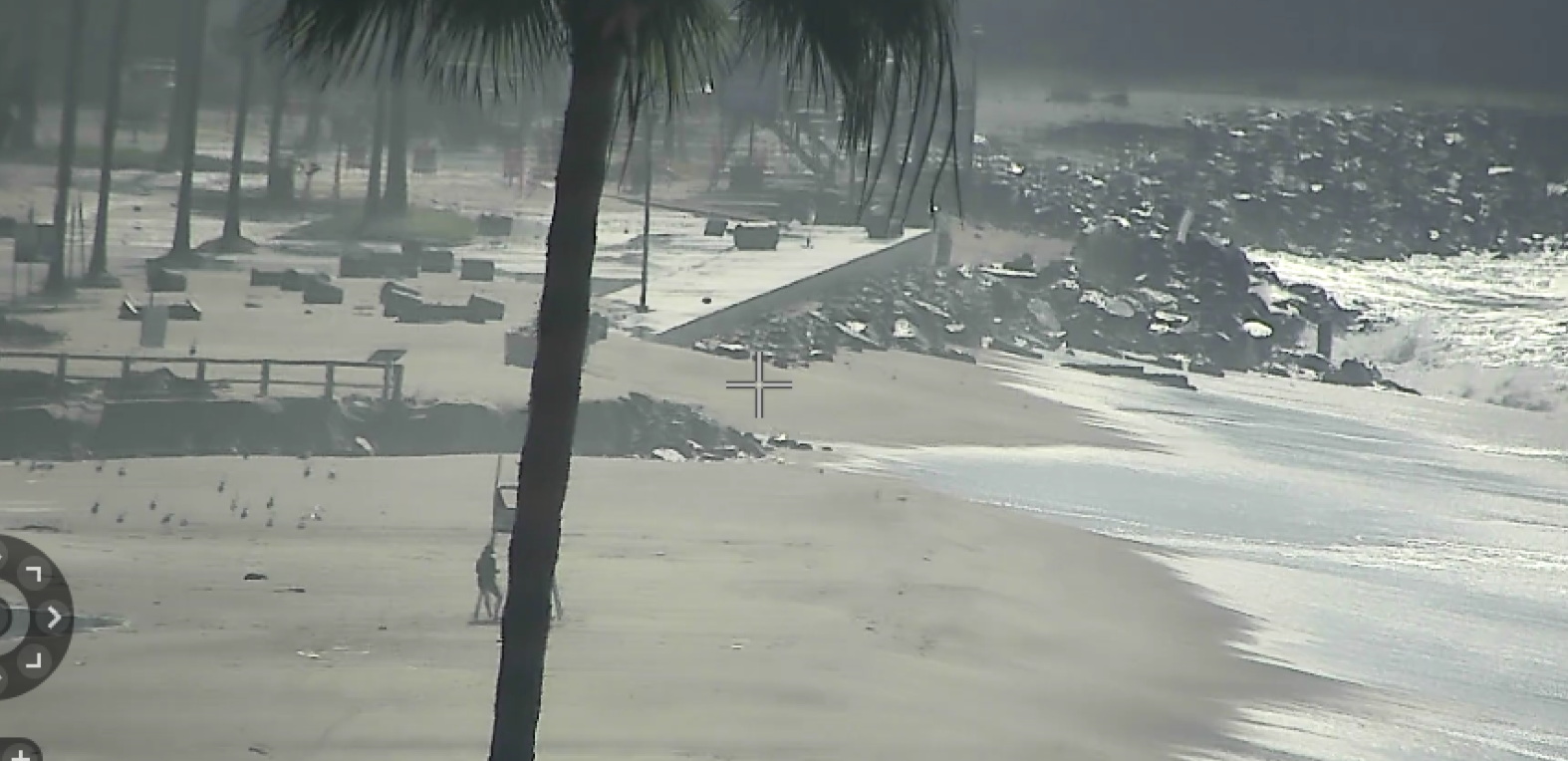
• Many noted (us included, of course) the Broadway / Coast Highway flooding.  This is occurring because of a combination of things – the storm swell, the tide level, and the possibility of the presence of a Kelvin Wave (which is not so much a wave, but a higher height to expected tides).  The tide level and waves push into the Laguna / Broadway channel and flood this low-lying area.  It is not wastewater, but it is pretty icky.  While we’ve got equipment out there working daily to clear the channel’s drainage, this isn’t an easy battle – folks should plan on that stretch of Coast Highway being impacted at high tides for several more days.  Use your secret detours, Laguna.

• Aliso Beach is taking some big hits.  While we added rip-rap following Hurricane Marie’s remnants, this one is hitting Aliso hard.  The waves picked up and moved cement trash cans and cement benches well into the parking area.  We’ve closed the coastal parking lot and are asking that folks – even pedestrians – stay away from there at least for the next few days, as the waves are projected to get larger.  It is not safe to be close to the water should a large wave sneak up on you.  As of about 10:30-ish this morning, the Aliso Creek berm naturally breached, as there was a lot of water backed up into the creek (post breach shown below).

• We’re watching the next few days.  We expect them to not be too rainy (but a bit windy) – our main attention will be on the shoreline.  If you see something, say something – use Ask Laguna for any situation you’re concerned about (unless it’s a life-safety event – then of course call 911).  Surfline projects that this event will be with us for 14-16 days, with today being NOT the extreme (!).

All in all, this is pretty significant.  Most Laguna long-timers say they haven’t seen it like this before.  Or at least in recent memory.  Please remind folks to be extra careful by the water, stay off rocks, stay aware of your surroundings, don’t go in unless you’re an expert swimmer or surfer, listen to lifeguards, call in problems when you see them – phew, that’s a lot.
It still will be a great fall weekend, though (band still playing tonight 5-7 at the Promenade, lots of other events, too) – please enjoy it and be careful out there.

$100,000 Walks Into a Laguna Election

Laguna caps donations at $500. This new committee started with $100,000.
Courtesy of The Weiss Report

For more than a year we have argued that Laguna Beach elections are not a level playing field. Incumbents run with name recognition, the free publicity that comes with the seat, and a donor network built over years in office. I have said that incumbents typically outraise newcomers at least two to one, and that the money gap is one of the strongest reasons we need term limits.

We were wrong about the size of the gap. It is much bigger than that.

The Gap Was Already Four to One
The candidates’ own Form 460 campaign finance reports for July 1 through September 19 show:
• The three incumbents, Mark Orgill, Sue Kempf and Alex Rounaghi, raised $132,929.
• The six challengers raised about $33,000 combined, not counting money candidates lent their own campaigns.
• Alex Rounaghi alone raised $65,242, nearly twice what all six challengers raised together.
That is a four-to-one advantage. And it is the money we can see, from donors limited to $500 per candidate under the City’s contribution limit.

$100,000 From a Single Company
On October 1, a new committee filed its first contribution report with the City Clerk. Its full name says it all: the Laguna Beach Good Leadership Committee Supporting Kempf, Rounaghi and Orgill for City Council 2026, Sponsored by Regency Properties LP and Affiliated Entities (FPPC ID 1497439).

Its Form 497 shows a single contribution of $100,000, received September 30 from Regency Properties L.P., and affiliated entities, of 1555 S. Coast Highway in Laguna Beach. One company sponsors the committee, and one company funded it.

The committee’s Form 497, received by the City Clerk on October 1, 2026, showing the $100,000 contribution from Regency Properties, L.P. Source: City of Laguna Beach campaign disclosure records.

That single contribution is more than three times what the six challengers have raised from all their supporters combined. It is the equivalent of 200 maximum contributions to a candidate, written in one check.

As of this writing, the committee has not reported spending any of it. But ballots are already in voters’ hands, and $100,000 buys a lot of mailers and ads in a town of 19,000 voters. When they arrive, check who paid for them.

How is this possible when the City limits contributions to $500? Because the limit applies to candidates’ own campaigns. Under state law and the Supreme Court’s Citizens United decision, an independent committee can raise and spend unlimited amounts, as long as it does not coordinate with the candidates it supports. The law requires independence, and I am not alleging that anyone has broken it. But for voters the effect is the same: one large donor can drown out hundreds of residents giving $100 or $250 at a time.

Same Donors, Two Campaigns
The filings also show how tightly the incumbents’ support is connected to the campaign against term limits. Several of the incumbents’ donors who gave to all three of them also gave to Citizens for Laguna’s Future, the committee formed to defeat Measure E. Among them are Joe Hanauer, Patrick Quilter, Christopher Quilter and Cody Engle. Not one sitting councilmember supports term limits. At the Village Laguna forum, all six challengers said yes to term limits and the incumbents said no.

So, the same network that is funding the incumbents is also funding the effort to make sure incumbents never have to step aside. And now a committee funded by a single company has joined them with six figures.

“Just Vote Them Out” Meets a War Chest People who oppose term limits say, “If you don’t like them, just vote them out.” That only works on a level field. When incumbents outraise challengers four to one and a single company adds $100,000 more, a newcomer is not running against an incumbent. They are running against a war chest. Read James Danziger’s article I posted today on Substack. https://georgeweiss.substack.com/p/why-i-will-vote-yes-on-term-limits

Measure E does not ban anyone from serving. It allows two consecutive four-year terms, then a two-year break, after which a former councilmember can run again. Eight years is enough to learn the job and finish projects. The break creates open seats where residents can compete on ideas instead of money. Twenty-eight of Orange County’s 34 cities already have term limits.

Follow the Money Before You Vote
Money only works if voters don’t know where it comes from. The best defense we have is sunlight.

• Look at the filings yourself. Campaign reports for all candidates and committees are public on the City Clerk’s campaign disclosure portal.
• When a glossy mailer arrives, check the “paid for by” line. Ask who is behind that committee and what they want from City Hall.
• Forward this to every Laguna Beach voter you know. Post it, share it, talk about it.
• Vote yes on Measure E and no to candidates that do not support it.
• Ballots are already arriving. Many of our neighbors will vote this week. Please make sure they know what is going on before they do.

*Sources: FPPC Form 460 campaign statements, July 1–September 19, 2026, for Mark Orgill, Sue Kempf, Alex Rounaghi, Nick Aronoff, Ashley Cintas, Joy Berry and Karen Martin; Form 460 for Citizens for Laguna’s Future (through Sept. 19, 2026); Laguna Beach Good Leadership Committee (FPPC ID 1497439), Form 497 contribution report filed Oct. 1, 2026; Village Laguna candidate forum, Aug. 31, 2026.

LB City Manager Special Weekend Update

Courtesy of Dave Kiff – Laguna Beach City Manager – Sat. Oct. 3, 2026

I’m writing this in between Council meetings because there seems to be confusion suddenly about “Residential Hillside/Protection” (RHP) properties.

Your “TL/DR” Version:

  • No, the City didn’t newly require open space easements over residential hillside properties.
  • No, the City doesn’t direct private property owners to install public trails.
  • No, the City didn’t newly classify properties with 30% slopes as environmentally sensitive areas.
  • Yes, we did add a 90-day response period for applications that are deemed incomplete – in large part because this is a recommended State standard and because sometimes folks just don’t get back to us at all.  Respond with something, please

In Greater Detail:

First, this email is primarily about properties zoned RHP.   If you don’t know how your property is zoned, you can always look it up here.  Use the map to find your property, then click on the parcel.  A window will pop up with parcel information.  It usually has two sections – on one of the two sections, you’ll find something that says “Zone District: R1” or “Zone District: R2” or “Zone District: RHP” or similar.

Let’s get back to the DR Efficiency Ordinance and the RHP Zone.  The RHP zone has a lot of acreage but is small in terms of the number of lots citywide – this zoning applies generally to large parcels that contain steep hillsides or canyons.  Typically these are parcels where at most one can have a single-family home, a yard, and related hardscape – and a lot of canyon or hillside.

Our new DR Efficiency Ordinance, which has been in the works since October 2024 (and has had at least 10 workshops), generally does these three things:

  • It made changes to which projects require Design Review. Many project types now require a lower level of review. Certain new single-family homes may qualify for an exemption if they are single-story, do not exceed 15 feet in height, and meet other requirements.
  • It reduced the number of Design Review criteria. The ordinance reduces the criteria used to evaluate projects from 16 to 11.
  • It put in place a hearing waiver option for Administrative Design Review. An application may be approved without a hearing if no hearing is requested through the waiver process.

You can view the full ordinance here (it’s item #20).

Here’s the kicker: the Ordinance did something that threw folks for a loop – it mirrored things that are in other parts of the Code and our General Plan.

In other words, aspects of the Ordinance simply reiterated current law.  Why would we do this?  Well, too many innocent applicants weren’t aware of certain existing zoning restrictions because they only looked at the Zoning Code, not the General Plan.  And they had early hopes/expectations for their projects solely based on the Zoning Code, not realizing that General Plan requirements apply, too.

Given how complex our codes and General Plan are, you need to look at both.  So the DR Efficiency Ordinance picked up the SAME LANGUAGE that’s in our General Plan – it didn’t revise, undo, or create new limitations for the RHP Zone.

So, as a Q&A:

1 – Did the City create a new requirement for residential hillside properties to dedicate land as permanent open space?  No. That was there under current law.  The ordinance links an existing General Plan requirement to the Zoning Code to make it easier for applicants in the RHP zone to find and understand.  For many years, Policy 14-J of the City’s Open Space/Conservation Element (see page 66) has required an offer of a permanent open space easement as a condition of approval for new development in certain hillside areas. The Open Space/Conservation Element is part of the City’s General Plan, which guides land-use decisions.  The City already applies this policy to new development in the Residential Hillside/Protection (RHP) zone, typically when reviewing a proposal for a new single-family home. Because development approvals must be consistent with the General Plan, the City includes the required offer of an easement as a condition of approval.

2 – What land is covered by the easement?   The easement generally covers portions of the RHP property that will remain in their natural state. It does not include areas used for your home, garage, hardscape, or other improvements, such as a landscaped backyard.  Many RHP properties are among the City’s larger developable lots. Preserving their undeveloped areas helps protect hillside open space over the long term (which is why the requirement is in the General Plan).

3 – Does the City take ownership of the land within the easement or require public trails?  No!  The property remains privately owned. An open space easement limits how the covered area may be used to preserve it as open space.  The City does not require owners to build public trails or other improvements within these easement areas, because we don’t own the property – the resident does. If someone wanted to do those improvements on their own land (hmmm – and I can’t see why they would), they’d have to initiate it herself or himself.

4 – Does the ordinance newly classify slopes greater than 30 percent as environmentally sensitive areas?  No. The Zoning Code already grouped slopes greater than 30 percent with environmentally sensitive areas when determining whether a project requires Design Review. The ordinance did not add or change that requirement.  The ordinance provides a way for a project to qualify for an exemption from this Design Review requirement if a licensed professional certifies that the proposed development will not affect an environmentally sensitive area, including a slope greater than 30 percent.

5 – Why do applicants now have 90 days to resubmit materials after the Planning Division finds an application incomplete?  Remember, this affects the first step that an applicant takes – she or he files a project application with the City, and we check all of the boxes to make sure that the submittal itself – before we even crack it open for analysis – is “complete” (i.e. all there), with the dozens of things that our complex code requires.  The 90-day requirement – which starts AFTER we’ve let an applicant know that something(s) is/are missing – helps keep applicants and the City on time with project approvals.

If someone wants to avoid coming up against the 90-day deadline, we’re happy to help you file the most complete application as you can BEFORE the clock starts and of course to work with you as you’re completing your submittal – just ask!  We’re simply trying to avoid the scenario where we get crickets back when we deem an application incomplete (crickets = bad).  The requirement also aligns with California Department of Justice guidance on 90-day resubmittal periods for housing development applications.

Thanks for reading and for helping us rebut confusion.  If you have any questions about this at all, please ask me, Matt Schnieder, or Anthony Viera.

Candidates don’t show their poker hands …

but WE do let you know what they have to ante up
Courtesy of Fair Game by Tom Johnson in Stu News

Running for office is not only about getting your name on the ballot, but also about raising money to promote all aspects of a candidate’s campaign. That includes but is not limited to printed literature, mailings, digital/online advertising, consultants, print advertising, yard signs, postage, polling, research and such.

So raising money is vitally important. The more you have, the more you can do.

Locally, with three seats up for grabs, here’s a look at the most recent filings from the end of September:

Incumbent Alex Rounaghi appears to be the big dog when it comes to his campaign war chest. He has raised $65,742, spent $25,728, has $36,404 in cash on hand and no debt.

Sue Kempf, another of the incumbents, has received $38,752 in contributions, spent $5,050 and has $33,702 in cash on hand. She also shows no debt.

Mayor Mark Orgill had contributions of $28,935, with $8,834 in expenditures, $22,059 in cash on hand and $1,958 of debt.

Ashley Cintas has raised $26,763, spent $8,856 and has $20,998 cash on hand, with debts of $17,091.

Joy Berry has raised $11,689, spent $1,043, with $10,646 in cash, also with no debt.

Nick Aronoff has raised $10,575, spent $4,852, has $6,908 in cash on hand and debt totaling $2,186.

Karen Martin raised $1,599, spent $1,169, has $430 of cash remaining and no debt.

The record search showed “pending totals” for both Edward Bayuk and Laura Parisi.

Donors of note, not necessarily by amount, but according to other factors are:

The Laguna Beach Firefighters PAC contributed $500 each to incumbents Kempf, Orgill and Rounaghi.

Howard F. Ahmanson & Fieldstead & Company reported a $2,710 independent expenditure supporting Rounaghi with a slate mailer. This is not considered a donation to Rounaghi’s committee and is legally separate from his campaign’s finances.

Sam Goldstein donated $500 to Rounaghi.

And former Laguna Beach Councilmember George Weiss gave $250 to Aronoff.

For the three seats open for the Laguna Beach Unified School District, five candidates are running. Here’s a look at their disclosure information.

Incumbent Dee Perry had contributions of $10,552, $3,388 in expenses and $7,164 in cash on hand.

Incumbent Joan Malczewski had contributions of $23,407, with expenses of $2,780 and $21,136 in cash on hand. She has outstanding debt of $784.

Elizabeth Bates has had contributions of $7,351, expenses of $3,484 and $3,867 in cash on hand.

Kimberly Smith has raised $28,105 this last period, with $2,666 of expenditures, and $25,438 in cash on hand. She also shows outstanding debt of $200.

Shaheen Sheik-Sadhal has raised $20,719, with expenses of $1,703, with $19,017 in cash on hand. She also has outstanding debts of $3,103.

Incumbent Malczewski is running on a slate with Smith and Sheik-Sadhal, while Perry is running with Bates.

Finally, there is the Measure E initiative. It asks a Yes or No to the following question: Shall an ordinance to amend the Laguna Beach Municipal Code by enacting a limit on consecutive years of service by members of the City Council to a combined total of two four-year consecutive terms, with the ability to again serve as a Councilmember after a lapse of service of at least two years, be adopted?

Reported Measure E contributions show $3,068 supporting the measure and $12,906 in opposition to it.

Ballots for Laguna Beach are expected to begin arriving Monday, Oct. 5.