by MJ Abraham
Courtesy of the Laguna Beach Independent
I have been a participant in the Nextdoor Laguna Beach community social media platform since it was introduced to our city more than a dozen years ago. I was impressed that one of our city leaders, Sue Kempf, was instrumental in bringing Nextdoor to Laguna Beach and continues to serve as a LEAD for the site today.
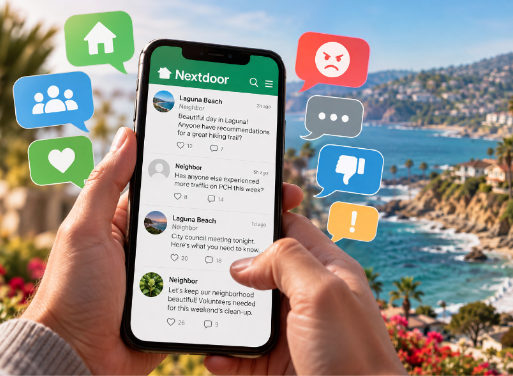 Nextdoor was introduced in Laguna Beach with a worthwhile goal: to improve communication, neighborhood connections, emergency preparedness and community engagement. In 2013, the City Council approved a recommendation from the Emergency Disaster Preparedness Committee to promote Nextdoor as a neighborhood-based social networking platform.
The concept was simple: provide residents with a free way to share information, report issues, connect with neighbors and become more aware of what was happening in their community.
At least, that was the intention. In its infancy, Nextdoor appeared to be well received by residents and city leaders. But over time, participation has grown, discussions have expanded beyond our immediate neighborhoods, and people from outside Laguna Beach—and even outside California—can weigh in on local conversations.
What was once a neighborhood communication tool can now feel much broader, more contentious and, at times, overwhelming.
There are also questions about privacy and moderation. Nextdoor relies on automated systems, user reporting and volunteer neighborhood moderators to enforce community guidelines. Residents can become LEADS or monitors and help oversee communications within designated neighborhoods. On the surface, this seems reasonable. But does asking local residents to help police their neighbors’ communications create problems of its own?
Today, Nextdoor can sometimes feel less like the community-building resource it was intended to be and more like another arena for conflict. What began as an opportunity to increase information, connection and awareness may also have come with a cost—in time, privacy, neighborly relationships and peace of mind.
Has Nextdoor accomplished what it was intended to accomplish? Has the City ever surveyed residents to determine whether they consider the program valuable? Has the platform strengthened relationships between neighbors—or, in some cases, pitted neighbors against one another? Has it become a place where people feel free to criticize, ridicule or bully others over their thoughts, feelings and opinions? And has it contributed to the larger political and social divisions we see in and beyond Laguna Beach?
We now hear city leaders, including Council Member Sue Kempf, making critical comments about Nextdoor, including referring to some discussions as “noise” and accusing people of bullying. At the same time, residents on different sides of community issues use Nextdoor to express concerns while sometimes criticizing the platform and its users.
So what exactly are we seeing?
Is public criticism simply “noise”? Is it bullying? Or can it also be an indication that residents are frustrated, concerned and trying to communicate with their community and city leaders on issues critical to them?
With an election year upon us, perhaps this is an opportunity to rethink how we use this resource. Rather than allowing Nextdoor to become another place for division and personal attacks, could it become a more constructive forum for civic engagement? Could residents use it to share information, ask questions, hear different perspectives and hold elected leaders accountable in a respectful and informed way? Could the site monitors stay true to the task they agreed to?
Nextdoor was introduced to Laguna Beach with the goal of bringing neighbors closer together. More than a decade later, perhaps it is time to take an honest look at whether it is still accomplishing that goal—and whether we can make better use of it for the greater good of our community.
Is Nextdoor Laguna Beach innocuous or a nuisance? Is our town connecting—or disconnecting—with one another? And during an election year, can we turn this resource into a more constructive place for civic dialogue, informed discussion and community engagement?