Ballot Measure E is a First Step to Election Reform
Courtesy of The Weiss Report on Substacks
In an ideal world, we would not need Term Limits but with the inherent advantages of incumbency and the unlimited funding from political PACs it’s needed today.
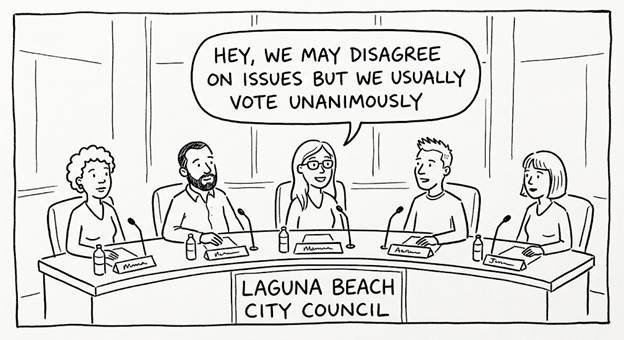
Laguna Beach City Council members like to talk about their “mandate.” It’s a useful word for anyone wielding power. It implies the public asked for this. But if you run the numbers from our recent Council elections, the mandate disappears.
A Plurality Isn’t a Mandate: Laguna Beach elects its Council members at large, and whoever gets the most votes wins a seat. But winning a plurality of votes in a multi-candidate field is a quite different from winning the backing of a majority of the electorate, and the false claim of “mandate,” that Council members lean on whenever they want to describe their agenda as reflecting “what the voters want.”
Some History: Bob Whalen received roughly 46.1% of all ballots cast in 2024. Hallie Jones received roughly 45.0%. Both fell short of majority support from the voters who turned out. Mark Orgill’s 2022 win came on just 4,359 votes. That number is not a mandate for anything. Alex Rounaghi is the clear exception: he crossed the 50% threshold outright in 2022. The only other Council members in recent history who won a majority of the vote were Rob Zur Schmiede and Kelly Boyd back in 2012. Sue Kempf’s 2022 result was close enough to that line that it needs the precise ballot denominator verified before anyone calls it a majority win.
Even if you give Kempf the benefit of the doubt and count both her and Rounaghi as majority-backed, that’s two Council members out of five. Nowhere in the current lineup do three members each carry majority support from the electorate. The bloc that controls every vote, every committee appointment, and every policy direction in Laguna Beach was not chosen by a majority of Laguna Beach voters, it was created by the council itself, after the fact.
Nobody Voted for the Coalition, or the Mayor: What the ballot never asked us is which of the five council members should govern together. Voters chose individuals, not a governing coalition. They didn’t rank preferences among competing blocs, didn’t get to signal which combination of colleagues they wanted running the city, and had no say at all in who would sit as mayor. That decision, arguably the most consequential one the Council makes about itself happens entirely after the election, behind closed doors, among the members, with zero direct input from the public that elected them.
This isn’t a problem unique to Laguna Beach; it’s baked into at-large council elections everywhere. But it does mean that the use of “mandate” needs to be retired from Council rhetoric.
What Laguna Beach has is a set of individually elected officials, several of whom fell short of majority support, who then formed a working majority behind closed doors. In this case there is a 5-member majority. That is how they vote. That’s not illegitimate. It’s just not a mandate and treating it like one insulates incumbents from a quite simple check: an actual expiration date.
Term Limits Are a Step towards Election Reform: If the electoral math doesn’t produce a clean mandate, the least the system can do is guarantee some turnover, regular chances for the public to reshuffle the deck, bring in people with new perspectives, and prevent any one plurality-elected bloc from calendaring the city’s future indefinitely. Term limits don’t fix the structural quirks of at-large plurality voting. But they put a ceiling on how long an unmandated majority can keep renewing itself.
Incumbency in a small town like Laguna Beach has its own advantages. There is name recognition, donor relationships, control of the dais, photo opportunities, free media coverage, control of the calendar, and support from special interest PACS, who expect and receive favors.
Much of that advantage was unearned, it was simply accumulated in office. Term limits are the one structural reform that directly counteracts that accumulation, without requiring us to rewrite how elections themselves work. Instead of allowing coalitions to form behind closed doors after an election, this forces those alliances into the open. It requires officials to build their coalitions publicly and on a predictable schedule.
Laguna Beach voters deserve a Council that has to keep earning its authority, not one that can point to a plurality win in one cycle and coast on the fiction of a mandate for the next decade. Term limits won’t solve every problem with how this city is governed.
But the are a needed first step for election reform, and one that is overdue.
To donate and support term limits, or for more information on Ballot Measure E please visit: www.nimblegov.org
George’s Substack is a reader-supported publication. To receive new posts and support my work, consider becoming a free or paid subscriber.