LBUSD Policy Didn’t Survive Contact With Power

Laguna Beach School Board’s majority spent years defending governance structures before deciding one of them wasn’t really mandatory after all.

For nearly two years, Laguna Beach has been told that governance matters.

Our policies and bylaws matter.

Transparency and process matters.

At least, that was the pitch to help elect Sheri Morgan and Howard Hills. It justified all of their governance committees, policy reviews, legal questions, public criticism of district leadership, and hours of board meetings spent debating how LBUSD should operate.

The promise was simple enough: institutions are stronger when decisions are made through transparent, established processes instead of the preferences of a few people in power.

Then came May 14, 2026, when a new superintendent was appointed. Suddenly, the process has become negotiable.

This is not a story about whether Dr. Don Austin is qualified, and it’s not even really a story about whether the board had the legal authority to appoint him. School boards have broad authority to hire superintendents, and no one needs to pretend otherwise.

The question is not whether the board had power, but how they used it.

For Howard Hills, his governance obsession did not begin when he was sworn in. For more than a decade, he has shown up around LBUSD with questions about leadership, process, board authority, and whether the district was following the rules closely enough. Howard built a public identity around governance language.

Sheri Morgan’s record fits inside the same frame. Her political brand has been transparency, access, and community voice. She has presented herself as someone trying to pull LBUSD out of a closed-door culture and into a more responsive, public-facing one. Whether you agreed with her or not, the pitch was clear: the old way was too insulated, too controlled, too dismissive of the community.

In 2026, that governance language became formal board work. LBUSD approved an Ad Hoc Governance Committee to review the district’s governance processes, including the clarity, organization, and alignment of board bylaws and policies with CSBA models, statutes, and board-adopted norms. Howard led the charge to create this committee because he insisted that governance structure mattered.

LBUSD’s own Board Bylaw 9310 says board policies are adopted to set clear procedural expectations for district governance. It says policies are binding unless they conflict with law or collective bargaining agreements. The district’s policy manual is supposed to be the framework for how the board governs.

But then Board Policy 2120 became inconvenient.

On June 4, 2026, Sheri Morgan defended the superintendent appointment by arguing that the prior superintendent search had not expired. According to her, the district had already conducted an extensive search less than a year earlier, Dr. Austin had stated he was part of that process, and restarting the work would be unnecessary, expensive, and fiscally irresponsible.

“There is no statute of limitations,” Sheri said. “There is no expiration date on that search process from less than one year ago. Restarting that process and redoing that work is not required by law or policy.”

She also said repeating a search that cost more than $50,000 and took four months would be “fiscally irresponsible.”

That is one argument. However, Howard Hills made another.

He did not simply argue that the policy had been satisfied. He actually argued that the policy was not mandatory.

“The bylaw is not mandatory and it’s not compulsive,” Hills said. Then he went further, saying the board could appoint a superintendent “any way the board wants to do it and any time.”

After all the speeches, all the policy debates, all the governance lectures, all the concern about procedure and institutional standards, Howard suddenly announced that the superintendent-search policy was not compulsory and that the board could, essentially, however it wanted, appoint a superintendent.

Funny how flexible governance becomes when it finally applies to them.

If Howard had never spent years questioning governance, if Sheri had never built her case around transparency, if the board had not created a committee around policy alignment and board-adopted norms, this might read like an ordinary disagreement over how much process is enough.

But that is not the record.

The record is a board majority that used process as both sword and shield until the moment process pointed back at them.

Dr. Joan Malczewski put the concern plainly during the June 4, 2026 board meeting. Search processes exist so institutions can protect themselves from the weaknesses of individual decision-making. They protect against bias, generate better information, create buy-in, and, most importantly, protect the institution and the person being hired.

A superintendent search process is not only about finding a good person. It is about creating legitimacy around the choice.

Joan was not informed that Don Austin was a candidate until the May 14, 2026 closed session, when she was met with a motion to hire him. She said she had no prior information that conversations were happening, no knowledge that negotiations were underway, and no role in determining a start date.

This was not a board-led process; it was a majority-led outcome.

There is a difference.

And that brings us to Dee Perry. Most conversations about the current board majority focus on Howard and Sheri, which makes sense. They speak the most, drive the arguments, and attract the heat.

But they cannot govern alone.

The majority is three votes, and their third vote is Dee Perry.

Dee’s role is quieter, but it is not smaller. She often appears surprised, uncomfortable, or only partially informed. She can seem adjacent to the controversy rather than central to it. But when the vote matters, Dee Perry is not a spectator; she seals everyone’s fate.

Howard and Sheri can argue, posture, explain, defend, and accuse. This allows Dee to remain aloof and pretend to be just a passenger along for the ride. And when she says she was “a little bit in the dark,” that does not make the vote easier for us to swallow. It should make it more concerning. If a trustee is unsure, uninformed, or surprised by how a major decision reached the board, that is the moment to slow the process down, not hand it the final vote it needs.

Dee may not be driving the car, but she keeps handing the keys to Howard and Sheri.

The board majority can keep saying this was about stability. They can say it was about saving money and avoiding another long search. They can say Dr. Austin was already vetted, so the policy was not mandatory. They can say the law allowed it.

Maybe some of that is true, but none of it answers the larger questions.

If governance mattered enough to build a political brand around it, why did it stop mattering here?

If policies matter when Howard and Sheri are criticizing district staff, former board members, or prior decisions, why do they become advisory when Howard already has the votes?

If transparency is the standard, why was the public asked to accept the explanation after the decision rather than being included beforehand?

And if Dee really was “a little bit in the dark,” why was she still comfortable becoming the light that turned the whole thing green?

This is about whether the board majority is willing to hold itself to the same governance standard it spent the last two years demanding from everyone else.

So far, the answer looks pretty clear.

Governance matters — until it gets in their way.

The Cost Shift Hiding in LBUSD’s Budget

Employee benefits are complicated, but the question is simple: will the Laguna Beach School Board protect its staff or ask them to absorb more?

In LBUSD’s proposed 2026–27 budget materials, one line immediately stood out to me.

The Budget Overview shows planned spending dropping from about $93.49 million to $90.15 million. Certificated salaries increase from about $35.57 million to $36.10 million, classified salaries increase from about $13.22 million to $13.58 million, and combined, salaries increase by about $892,000.

Employee benefits go down.

They decrease from about $21.60 million to $21.45 million, a drop of roughly $145,000. The budget shows certificated salaries up 2.1%, classified salaries up 2.7%, and employee benefits down 0.7%.

That is what sent me down the rabbit hole.

I know school district budgets are mostly people, as they should be. Public education runs on teachers, aides, counselors, office staff, custodians, specialists, nurses, administrators, and the people who keep the system functioning every day.

In California, roughly 80% of current school spending goes toward staffing and LBUSD is right in that range. The district’s 2025–26 budget stated that compensation accounted for 77% of the general fund. For 2026–27, LBUSD lists about $71.14 million in personnel and staffing costs against a $90.15 million spending plan. That is about 79%, with the caveat that overall planned spending is lower, which makes compensation a larger share of the budget.

So the issue is not that Laguna spends too much on employees, but what happens when a small raise meets rising healthcare costs.

LBUSD’s benefits line is not just health insurance. It includes STRS, PERS, Medicare, unemployment insurance, workers’ compensation, retiree benefits, OPEB, and health and welfare benefits. In the proposed 2026–27 budget, total employee benefits are about $21.45 million. Health and welfare benefits are about $5.50 million of that total, or roughly 6.1% of the district’s entire spending plan.

Healthcare costs themselves are moving fast. Nationally, the average employer-sponsored family premium rose 6% in one year, and single coverage rose 5%. California is even higher, with family premiums increasing 24% since 2022, outpacing both inflation and wages.

So when LBUSD shows a small salary increase and a decrease in benefits, the public should ask what employees are actually gaining.

A 2% raise can disappear very quickly when healthcare premiums increase. A raise on paper can become a wash in real life. For some employees, especially those covering a spouse or family, it can become a loss.

The Michael Bishop healthcare review helped me understand why this is so complicated.

LBUSD’s health plan year begins October 1, and the district’s fiscal year begins July 1. That means the district builds and adopts its budget before final healthcare renewal rates are fully known. The district is budgeting on one calendar while healthcare costs move on another.

Then there are the plans: PPO, HMO, individual, spouse, children, family. Employees get married, divorced, have babies, retire, change jobs, add dependents, lose dependents, and move between eligibility categories. Those changes do not always happen neatly at the start of a fiscal year.

I am not pretending to be a healthcare expert. I am learning this as I go because the budget number did not sit right with me. But the more I learn, the clearer it becomes that this system is easy to get wrong without serious guardrails.

The review found that from 2022–23 through 2025–26, employee contributions were not set in accordance with the collective bargaining agreements. The district covered a larger share of the total annual healthcare costs than it should have under the contract.

The review also points to a systems problem: timing issues, multiple plans, multiple tiers, changing employee census data, contribution caps, and the need for better coordination between Human Resources and Business Services. The recommendations focus on controls, communication, budget comparisons, review of the cap structure, review of plan design, and possible alignment of the plan year with the fiscal year.

But this should not become a quiet excuse to reduce benefit support.

Under the contract, the district pays up to a negotiated cap, and employees pay what is above it. For example, certificated PPO family coverage, the annual district cap is about $25k. The 2025–26 PPO family premium is about $39k, leaving the employee responsible for about $14k, or $1.4k per contribution period.

For Kaiser HMO family coverage example, the annual district cap is about $21k. The 2025–26 premium example is about $28k. That leaves the employee responsible for about $7k, or about $700 per contribution period.

Those are not small numbers, and that is why salary and benefits have to be discussed together. A district can offer a modest raise, hold to the cap, reduce its benefit costs, and still leave employees carrying a larger share of the burden.

That may be legal under the contract or clean on a spreadsheet, but it still deserves public scrutiny.

The 2021 MOU shows that the district has used bargaining to address healthcare pressure before. LBUSD and LaBUFA agreed to cover increased health and welfare benefits of about $350,000. To me, that says the pressure on healthcare costs was already obvious. The district and union saw the strain and reached an agreement to address it.

Now we are back in a similar moment, only with active negotiations.

I know the public is not privy to what either side is proposing and I understand bargaining has rules, which exist for a reason.

But the budget, review, caps, and board’s financial choices are public. So the community should come to the board with direct questions at June 8th’s meeting.

What is the board’s plan to protect employees from rising healthcare costs?

Is the district budgeting for a real compensation increase, or only a raise that gets eaten by premiums?

Will the board consider additional benefit support, a different cap structure, or better plan design?

How will the district address administrative failures without turning the correction into a cost shift?

What solution is the board willing to own?

LBUSD is not a district scraping by. Our proposed 2026–27 budget describes strong financials, full funding of LCAP goals, healthy reserves in other funds, and a AAA stable rating. Money is never unlimited, but choices exist.

This district prides itself on excellence. But excellence is expensive because good teachers, classified staff, counselors, specialists, and support employees do not stay because a district says nice things about them at board meetings. These people stay when compensation reflects the cost of living, healthcare costs, and the value of the work.

I started with one line in the budget and ended up with a much bigger concern.

Healthcare benefits are complicated, and the review proves that. Rising healthcare costs are real, and the state and national numbers prove that too.

Now the board needs to prove that fixing an administrative problem does not mean lowering support for employees and that a small raise will not be allowed to disappear into healthcare costs.

They need to prove that Laguna Beach Unified is still willing to invest in the people who make the district worth bragging about.

Federal ADA complaint filed over graduation relocation

On June 2, 2026, William Breit and Kathleen Christoff filed a civil-rights complaint against the Laguna Beach Unified School District in the U.S. District Court for the Central District of California (Southern Division) as Case No. 8:26-cv-01418.

The complaint pleads three claims arising from the February 26, 2026 board vote that relocated the 2026 Laguna Beach High School graduation from Guyer Field to the Irvine Bowl: violation of Title II of the Americans with Disabilities Act (42 U.S.C. §12132), violation of Section 504 of the Rehabilitation Act (29 U.S.C. §794), and violation of California Government Code §11135.

The plaintiffs are described as mobility-disabled invitees of graduating students. The complaint alleges the Irvine Bowl (maximum capacity ~2,600) provides only 11 wheelchair-accessible spaces and 12 companion seats, clustered in three non-dispersed areas, with steep approach and interior circulation, and that the district relocated the ceremony without a pre-vote ADA accessibility evaluation.

It seeks declaratory relief and a temporary restraining order plus preliminary and permanent injunction barring graduation at the Irvine Bowl, and attorneys’ fees, and states a separate U.S. Department of Education Office for Civil Rights complaint had already been filed. Counsel is Dykema Gossett LLP (James S. Azadian, Christine Mardikian, David Ter-Petrosyan).

Arbitrator awards $1.34B in O.C. real estate fraud case

Laguna Beach businessman Mohammad “Mo” Honarkar won a landmark $1.34 billion arbitration award against financier Mahender Makhijani, Continuum Analytics, and affiliated entities. The award includes $652 million in punitive damages and $326 million in compensatory damages following a fraudulent takeover of his Southern California commercial real estate portfolio. 

The dispute centered on the MOM CA Investco joint venture, which took control of Honarkar’s assets, including the historic Hotel Laguna. The arbitrator found the opposing parties liable for fraudulent inducement, breach of contract, and unlawful business practices. Makhijani’s group allegedly forced Honarkar out of his properties, which later led to Chapter 11 bankruptcy proceedings and receivership.

Following the arbitration victory, Honarkar’s entities successfully moved to dismiss the bankruptcy cases, clearing the path to return to state court and enforce the massive financial settlement.
The legal developments can be tracked through coverage from the Los Angeles Times or the Daily Journal.

City Council Candidates 2026 Elections

City Council Candidates:

1) Alex Rounaghi – EMAIL XXX – Campaign Website XXX. Turned in nomination papers: XXX (Candidate Statement & Signatures verified by the ROV)
Check out Candidate Community Related Articles and Opinions: Alex Rounaghi

5) Bob Whalen – bwhalen@lagunabeachcity.net – http://www.bobwhalenforlbcouncil.com. Turned in nomination papers: AUGUST 6, 2020 (Candidate Statement & Signatures verified by the ROV)
Check out Candidate Community Related Articles and Opinions: Bob Whalen

City Clerk Candidates:

1) Ann Marie McKay – http://mckay4cityclerk.com. Turned in nomination papers: July 30, 2020 (Candidate Statement & Signatures verified by the ROV)
Check out Candidate Community Related Articles and Opinions: Ann Marie McKay

2) Mariann Tracy – https://marianntracy.com. Turned in nomination papers: AUGUST 5, 2020 (Candidate Statement & Signatures verified by the ROV)
Check out Candidate Community Related Articles and Opinions: Mariann Tracy

Media and General Public Candidate Related Articles and Opinions for the November 3, 2020 Election Below: As Available…

Letter to the Editor – LTE-Dicterow 

Letter to the Editor – LTE-Weiss-Flores

2026 PAC and 501(c)4 Group Campaign Disclosure Forms

Citywide PAC Campaign Contributions Spending 2020 Election:

Laguna Residents First (PAC):

Laguna Residents First – 460 Jan 1 – June 30 2020 – redacted – Click here


Laguna Matters (PAC):


Liberate Laguna (PAC):

Liberate Laguna – 460 Jan 1 – June 30, 2020 – Click here

Village Laguna (PAC):

Village Laguna – 460 Jan 1 – June 30, 2020 redacted – Click here

Village Laguna PAC Form 496 Oct. 2 2020 (Flores) – Click here

Village Laguna PAC 496 Oct. 2 2020 (Weiss) – Click here

Laguna Beach Police Employee Association  (PAC):

Laguna Beach Police Employee – 460 Jan 1 – June 30, 2020 – Click here

LB Police Assoc. From 496 Oct.5, 2020 (Dicterrow) – Click here

LB Police Assoc. Form 496 Oct 6 (Whalen) – Click here

Laguna Beach Fire Fighters Association (PAC):

Laguna Beach Firefighters Association – 460 Jan 1 – June 30 2020 – Click here

Laguna Public Recreational Facilities Conservancy (LPRFC) (PAC):

LPRFC City Candidate Endorsement – Click here

Laguna Beach City Elections 2026

Candidates’ information and statements Here
PACs and Local Organizations Campaign Support Here
Candidate Financial Support Recap-Here

GET TO KNOW LB CANDIDATES BEFORE YOU VOTE THEM INTO PUBLIC OFFICE TO REPRESENT YOU!

Thank you for being an informed voter. Our city’s health and future depends on it!

Laguna Beach Residents – our local leaders affect our daily lives.

Our elected officials represent US.They represent our values, our lifestyle, our space and place within our city, county, state and country. They become our face and our voice.

A council position is the most important, influential and powerful position in our City. It is critical that we understand the broad range of experience and expertise needed for this position and that we select the right individuals to work together to lead.

As we consider the candidate choices in this 2020 election, it is important that we take the time to learn all we can about each candidate before considering them as a top-level public office representative for our City.

Elected Officials Roles and Responsibilities

The responsibilities of our local elected officials include dictating local laws, policies and budgets. This person(s) will make decisions about our money, ocean, properties, roads, trees, traffic, businesses, safety, and quality of life in everything that we see, live and breathe every day.

As important as this responsibility is, local individuals are often elected by voters who know very little about their personal lives, professional occupation experience, successes or failures, interpersonal skills, visionary and leadership skills, and most important their ability to oversee a complicated city government’s operations, assets, multimillion dollar annual budget and other financial and legal activities.

The folks we elect are game-changers. It is up to us to determine if they are the right fit by evaluating their ability to meet our needs. We must explore their qualifications and history with every bit of scrutiny we would give to anyone holding our destiny in their hands because the consequences are great. Their education, experience and success will move us forward, or quite possible risk us becoming stagnant or going backwards.

We must keep in mind that this isn’t a volunteer position or a social membership. It is a paid position with benefits and the person hired to fill it will be in a decision making capacity that will impact our futures. 

Click here for CC compensation/benefits.

Like many of us, individuals who run for CC will be our friends and/or acquaintances. For some, this poses a loyalty issue. We encourage you dig deep this election and ask yourself objective questions such as;

  • Do I continue the status quo in every election? 
  • Do I take the time to find representatives that have proven their value to the community? 
  • Do I elect individuals that have proven they can make sound and logical decisions on my behalf? 
  • Am I pleased with the position and direction my City is going in?
  • Have I reviewed the incumbents voting records?  Do I agree with them a reasonable percentage of time?
  • Have the incumbents listened to the majority of constituents?
  • Do the incumbents lean towards special interest groups?   
  • Do I elect an individual based upon professional eligibility and proven performance ad success or do I elect only friends I know? 

Sounds so simple, right? It’s not. It’s time consuming and often confusing.

Sadly, local voter numbers are in decline. This is hard to understand since local elections give voters the greatest voice and opportunity to be heard. Our local officials are elected to represent the majority, and when a large fraction chooses not to vote, small groups rule and thus bias is prevalent. This hurts us all.

Get Involved. Local elections take place every year and they have long lasting implications.

By choosing the most experienced, trustworthy and transparent representatives, voters can help create and pass laws reflective of how we feel. Local politicians play a major role in all of the decisions that have a direct influence on our day-to-day lives. Our laws, streets, safety, education, thriving and healthy communities are influenced by their ability to leverage our tax dollars and make good financial decisions for us.

Our local elected officials decide how our public safety is managed. They have input as to how our police officers are trained and ensure that self-policing is in place and monitored. Sometimes local citizens take action to make their voices heard as well as keeping the check and balances needed so the majority of interests do not take over.

Our local politics can shape federal policy. When you elect officials who support the causes you believe in, you become part of making a change at a state level. As states address issues and revise their laws some eventually are adopted at the federal level. The Federal government often waits to see how the new law evolves at the state level to determine its value. They may also nullify state laws if they choose. Our elected officials become our voice at all levels of government.

This election year, we have 5 City Council candidates – 2 are incumbents.  LBCHAT has included individual candidate information and any/all public information documents the may provide you with more insight into each candidate.

Candidate Public Forums:

City Council Candidates:
Alex Rounaghi / Incumbent* SOQ and Disclosure Forms

City Clerk Candidates:
Ann Marie McKay SOQ and Disclosure Forms
Mariann Tracy SOQ and Disclosure Forms

Political Action Committees (PAC): Disclosure Forms
Laguna Residents First (LRF) PAC
Liberate Laguna (LL) PAC
Village Laguna (VL) PAC
LB FIrefighter’s Association PAC
LB Police Employee Association PAC
Laguna Public Recreational Facilities Conservancy (LPRFC)(PAC)

OTHER: Individual Reported 2026 Campaign Contributions
2026 campaign contribution 24 hour report Disclosure Forms

CC Candidate Public Background Records – ELECTION 2026
LBChat provides candidate personal and professional information to assist voters in
vetting individuals seeking public office in Laguna Beach.

LBCHAT will publish all public documents related to public office campaigning including:
candidate qualification statements, campaign finance disclosure forms and related
financial information, websites/podcasts, candidate forums, news articles and personal
and professional public information obtained from candidates and through public
information sources. In addition, a Laguna Beach Police contact report listing: arrests,
restraining orders, repossessions and other violations will be obtained in accordance
with the California Public Record Act. Code# 6253 (CPRA)

_______________

2025 Campaign Disclosures:

LAGUNABEACHCHAT.COM
CHAT stands for City Hall Accountability and Transparency. Our Mission: Laguna Beach
CHAT desires to advance accountability and transparency. We serve residents by
providing them with an open and honest platform to gain knowledge about City officials,
functions and decisions that impact our quality of life and our local community.
We welcome resident/voters opinions and feedback. Please share them with us.
Send to: contact@lagunabeachchat.com.

Thank You. Was this helpful? Please send us your feedback (click here)

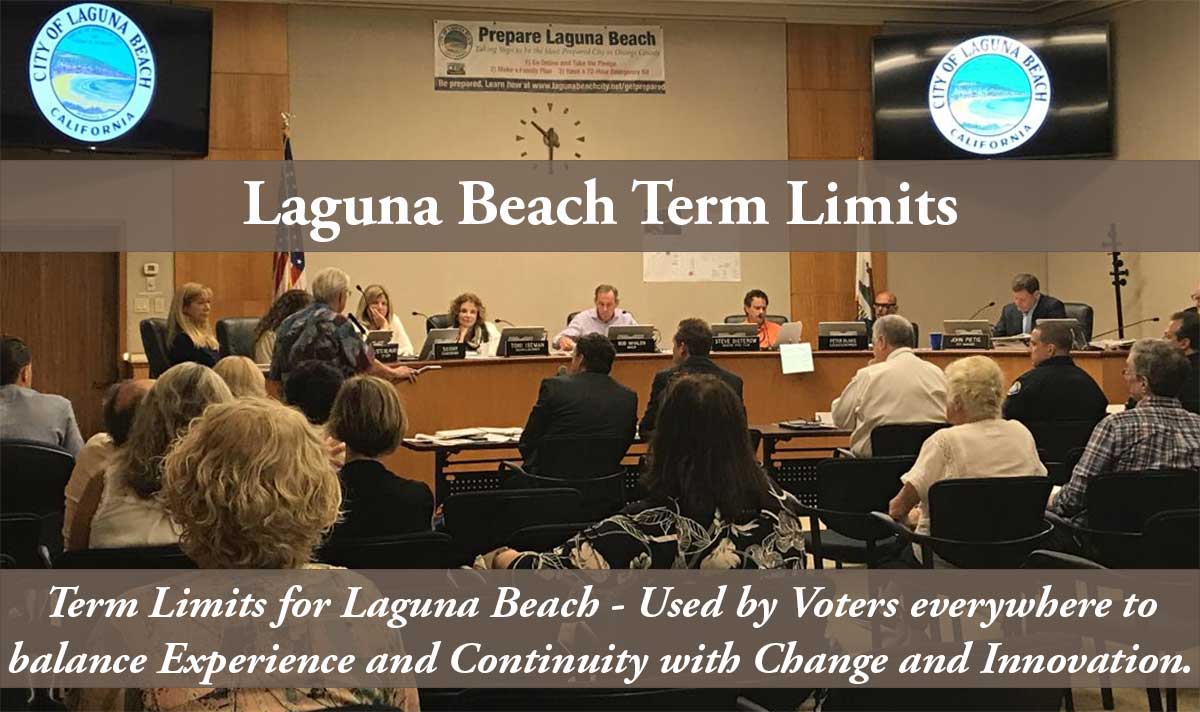
Laguna Beach Term Limits On The 2026 Ballot

Information is courtesy of www.nimblegov.org

With 82 percent of Orange County cities having term limits for their council members It’s time for Laguna Beach to adopt Term Limits.

Let’s continue the Term Limits dialogue here in Laguna Beach.  NimbleGov.org is a group of local volunteers who have successfully brought this issue to the 2026 General Election ballot.  This November, we will all get to vote on this important issue.

As you can see from the official summary issued by the City Clerk (See Below) this is exclusively about Laguna Beach, and exclusively about term limits for our city council. This action is local to Laguna Beach. It is independent of any group or party.

This is a simple process:

  1. In the November 3, 2026 election, registered Laguna Beach voters will cast their ballots either for or against term limits.
  2. If the majority votes for term limits, then the term limit clock starts from zero with the  election. (terms served before the 2026 elections do not count toward term limits).

There are term limits for the President, term limits for the Governor, term limits for the Orange County Board of Supervisors, and term limits for the vast majority of cities in Orange County.  Those who want to stay in power longer often spend money to convince you otherwise, but this is a question that you get to answer for yourself.