
Author: LBChat
What Laguna Should Understand About the Healthcare Issue
By Briana Heathcott
Laguna Beach
The healthcare contribution issue at Laguna Beach Unified deserves a clear explanation because the amount of noise surrounding it has obscured the underlying facts.
For several years, some employee healthcare deductions were calculated incorrectly. The District continued paying insurance premiums, but certain employees were not charged the amounts required under the established contribution formulas.
At the November 13, 2025 Board meeting, Assistant Superintendent of Business Services Manoj Roychowdhury explained that the problem resulted from weak internal controls, communication gaps between Human Resources and Business Services, conflicting fiscal and insurance-plan calendars, the absence of an annual reconciliation process and incorrect contribution rates published in the Employee Benefits Guide.
This was an administrative failure, but it was not created by employees.
They did not establish contribution formulas, publish benefits guides, administer payroll, or determine the deductions on their paychecks.
Board President Dee Perry made that distinction clearly: “Our employees should not have to pay for these errors, and I’m certain we can find a way to handle this without burdening our wonderful staff.”
As someone who has worked in HR for 20 years, I agree.
Benefits administration is complex. Insurance rates change annually. Employees add dependents, change plans, marry, divorce and experience other life events that affect payroll deductions. Those changes must be coordinated across insurance records, payroll systems, contracts, contribution tables and employee communications.
Mistakes can occur without malicious intent. Accountability means identifying the problem, correcting it and strengthening the process.
The District did exactly that.
Roychowdhury outlined annual reconciliations, improved coordination between departments, specialized staff training, outside consulting support and efforts to simplify the benefits structure.
“We have recognized the error and now we should move forward, close the error to make us whole and move ahead with improved processes.”
At the December 16, 2025 special meeting, he presented four corrective-action options.
The Board unanimously chose to absorb the approximately $1.04 million cumulative cost rather than seek repayment from employees.
The error was investigated. The procedures were corrected. The financial decision was made.
Yet public discussion continues to focus on inflated figures and repeated suggestions that employees received something improper. That does not improve accountability—it distracts from the more important conversation about the future of employee healthcare.
Over roughly six years, healthcare premiums increased nearly 30 percent while the District’s contribution caps barely changed. As insurance costs rise without corresponding employer contributions, employees bear a growing share of the expense.
That is the issue Laguna should be debating.
Healthcare benefits are compensation. Every employer must decide how much to invest in them to recruit and retain talented employees. Laguna Beach should make that decision intentionally through collective bargaining using accurate information—not misinformation about a resolved accounting error.
Our teachers and staff educate the future doctors, artists, engineers, business owners and public servants who will shape our community.
The District should remain accountable for what went wrong.
But accountability should lead to better policy, not become an endless political distraction. The question now is whether Laguna Beach will support sustainable healthcare benefits for the people who educate our children.
Ballot Measure E – Term Limits
The City of Laguna Beach is governed by a five-member City Council whose members are elected by Laguna Beach voters to four-year tenns of office. Cun-ently, the City of Laguna Beach does not have tenn limits on elected City Council office.
Measure E was placed on the ballot by a citizens’ initiative petition. On December 9, 2025, the City Council voted to place Measure E on the November 3, 2026 General Municipal Election, in compliance with the California Elections Code.
If approved by a majority of voters (50% +1), Measure E would add Section 2.04.080 to the Laguna Beach Municipal Code to establish term limits on City Council service. Measure E would provide that no person may serve more than two consecutive four-year terms as a Council Member. In the event a person is appointed or elected to fill a vacant City Council office for less than two years of a four-year term, that individual will be eligible to serve two consecutive fouryear terms thereafter.
Click here for more information on Ballot Measure E
Click here for the full Laguna Beach City Attorney’s imparcial analysis
The field is set: nine council candidates for three spots
Fair Game by Tom Johnson
Courtesy of Stu News
August 7th has come and gone. That was the final day for someone wanting to run for City Council and/or a school board seat to file the requisite paperwork to qualify for the November ballot.
When the dust settled, here’s the final City Council lineup for Laguna Beach:
Nick Aronoff
Edward Bayuk
Joy Berry
Ashley Cintas
Sue Kempf*
Karen Martin
Mark Orgill*
Laura Parisi
Alex Rounaghi*
(* denotes incumbent)
The following Voter Initiative will also be on the ballot for residents to decide – Implement Term Limits for City Councilmembers.
It asks:
Shall an ordinance to amend the Laguna Beach Municipal Code by enacting a limit on consecutive years of service by members of the City Council to a combined total of two four-year consecutive terms, with the ability to again serve as a Councilmember after a lapse of service of at least two years, be adopted?
Simply: Yes or No?
• • •
Obviously, one great way to decide who to cast your vote for is to attend an upcoming candidate forum. Here’s what’s scheduled so far:
August 31 – Village Laguna Council Candidate Forum, 6-8 p.m. at the City Council Chambers.
September 26 – LBAA Candidate Forum, 9 a.m.-12 p.m. in the Forum Theater on the Festival of Arts grounds.
• • •
Equally as important, perhaps even more so to parents, is the race for the Laguna Beach Unified School District Board of Education. Here’s how that shook out at closing time: Five candidates, vote for three.
The incumbents are Joan Malczewski and Dee Perry; others challenging include Elizabeth Bates, Shaheen Sheik-Sadhal and Kimberly Smith.
This will be a race where you either support the present direction of the board/district, or you don’t. And it has been controversial. It will take one candidate aligned with the current direction to keep the majority with current board members Sheri Morgan and Howard Hills; it will take three candidates to create a new majority and potentially take the board in a different direction.
In the meantime, board member James Kelly, Ph.D., who has served on the board since 2018, has decided to hang it up, completely opening up his seat.
We join with many to thank him for his service and commitment.
Cities and Housing Progress – City Manager’s Update
As you hopefully sit outside in a lounge chair with your tablet and doomscroll / check in on things, this is very much worth your time:
Almost nowhere in California is building enough, according to the state.
You can do this too, but when I put in “Laguna” I get:
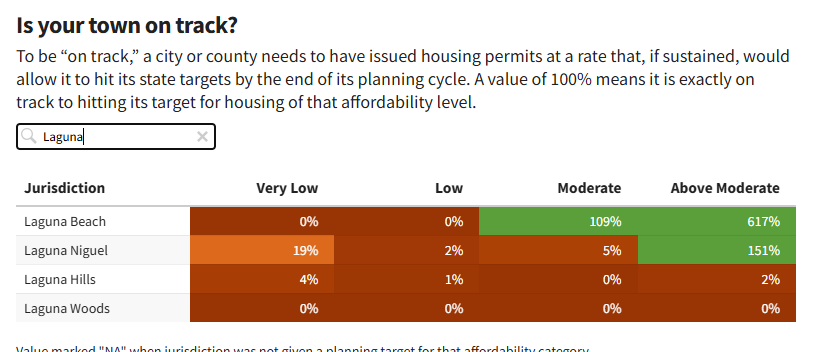
If you don’t already subscribe to Cal Matters, I recommend it. Their reporting is consistently fair (IMO) and thorough.
Resident Questions Candidates Honesty On Nextdoor
Candidates asking for our votes should not be shutting community members out of the conversation.
Courtesy of Briana Heathcott on Nextdoor
I recently learned that community members who have disagreed with or challenged the Laguna beach school board candidates are being blocked from their pages on social media. Their comments are also being deleted.
That is incredibly disappointing.
School board members represent the entire community — not just the people who support them. Elections should be an opportunity for candidates to hear different perspectives, answer difficult questions, and demonstrate how they will engage with people who disagree with them.
Blocking community members may make a campaign page more comfortable, but it doesn’t build trust. And it raises a fair question: If disagreement is shut out during the campaign, what should residents expect after the election?
We don’t all have to agree. In fact, we shouldn’t. Healthy communities need respectful disagreement, transparency, and leaders who are willing to engage with criticism rather than simply make it disappear.
Whatever candidates you support, I hope we can agree on that standard.
The names for this November’s ballot listing …
The names for this November’s ballot listing Laguna Beach City Council candidates is growing, with still several days available for nomination, ending at 5 p.m. this Friday, Aug. 7.
Courtesy Fair Game Tom Johnson in Stu News
So far, all three incumbents have pulled papers, including Mayor Mark Orgill and Councilmembers Alex Rounaghi and Sue Kempf. Kempf and Orgill have also both returned their respective paperwork, becoming officially qualified.
Of the challengers, Nick Aronoff is also officially “in.”
Then there are the newly announced candidates in the last several days that include Edward Bayuk, Joy Berry, Ashley Cintas and Karen Martin.
Martin brings experience as a land use principal with Pacific Planning Group; Cintas is a restaurateur with Oto Sushi; Berry has Silver Lining Hospitality and Bayuk’s credentials point to being a “consultant to Retail Wholesale Energy Industry Oil/Gas/Electrical & High Frequency Emergency Communication and Real Estate Management.”
It might’ve been easier to say what Bayuk isn’t involved in, but that’s a story for another day.
LBUSD 2026 Election
A clear guide on LBUSD board candidates, the proposed school bond, statewide education races, and the choices affecting Laguna Beach schools.
Courtesy of A Public Record for Laguna Schools
Three seats on the Laguna Beach Unified School District Board of Education are up for election on November 3, 2026.
Laguna Beach voters may also be asked to decide whether to approve a school facilities bond. At the state level, voters will select California’s next Superintendent of Public Instruction and weigh other candidates and measures that could shape public education.
This page will be updated as the ballot is finalized.
Last updated: June 26, 2026
On the Ballot
LBUSD Board of Education
Three seats are up for election. The terms currently held by Dee Perry, Jim Kelly, and Joan Malczewski expire in December 2026.
Candidate filing takes place from July 13 through August 7.
- Dr. Joan Malczewski (incumbent)
- Dee Perry (incumbent)
- Kimberly Smith
- Shaheen Sheik-Sadhal
- Elizabeth Bates
Proposed LBUSD School Bond
LBUSD is considering placing a general-obligation facilities bond before voters in November. The measure has not yet been formally placed on the ballot.
Once the final measure is approved, this section will include:
- What the bond would fund
- The amount requested
- Estimated property-tax impact
- Project priorities and timelines
- Oversight and accountability requirements
- Arguments supporting and opposing the measure
- Links to district documents and independent coverage

Guess Who’s Coming to Fund: School Bonds
·
Read full story
California Superintendent of Public Instruction
The State Superintendent is California’s elected public-schools chief and leads the California Department of Education.
This section will include a guide to the general-election candidates, their backgrounds, education priorities, public records, and positions on issues affecting California schools.
LB Schools Need Board Trustees Who Know Their Job
What LBUSD’s recent history can teach voters about power, process, and responsible governance.
By Erika Hennon Rule
Courtesy of A Public Record for Laguna Schools

One of the most important things I have learned from studying school board governance is that poor governance rarely announces itself and will usually show up under a much nicer name: responsiveness, urgency, efficiency, transparency, and community input.
I have spent the last couple of years watching Laguna Beach Unified board meetings, reading agendas, and trying to understand how an idea becomes a district decision. Somewhere along the way, the California Education Code and board bylaws became recreational reading. This has done very little for my social life (thank you to my friends and family for listening to my newfound knowledge), but it does satisfy the part of me that wants to know how public systems are supposed to work, where authority ends, and why certain procedures were put in place before someone decides they are inconvenient.
As summer break begins, LBUSD is heading into another superintendent transition, a new budget cycle, and a board election in November. We do not yet know the full field of candidates, but before the mailers arrive and everyone discovers a passionate commitment to transparency, it seems worth deciding what the job actually requires.
What kind of school board would serve this district well?
We do not have to answer that question on instinct, since California law provides a solid framework. The California School Boards Association offers guidance, and LBUSD already has policies and bylaws that define responsibilities. Other districts have built governance systems that Laguna Beach can learn from.
The harder part is finding trustees who believe those rules still matter when they slow down something the board wants to do.
The California Education Code gives school boards broad authority. Section 35010 places school districts under the control of a governing board. Section 35160 gives boards wide latitude, provided their actions are consistent with the law and the purposes of public education. Section 35161 allows boards to delegate responsibilities while still holding ultimate accountability.
That authority belongs to the board collectively, but it does not make board members district administrators.
The board governs through policy, budgets, contracts, goals, superintendent hiring and evaluation, bargaining direction, accountability systems, and public votes, while the superintendent and staff run the district. Education Code Section 35035 identifies the superintendent as the board’s chief executive officer and assigns responsibilities involving implementation, budgeting, staffing, financial reporting, and carrying out district plans.
Essentially, the board sets the direction, the superintendent carries it out, and then the board monitors the work and evaluates the results.
This arrangement is not complicated, but it can quickly become messy when individual trustees act as though they have their own chain of command. Staff should not have to sort through competing instructions, and the public should not have to guess whether a decision came from the board, the superintendent, a site administrator, or one notably persistent trustee.
An engaged board should ask difficult questions, demand reliable information, examine budgets, evaluate the superintendent, and push for better results without taking over the work. The line gets crossed when trustees begin deciding which employee should handle a task, which vendor should be selected, which venue should be used, or which public complaint should be assigned to staff immediately.
For LBUSD, that distinction stopped being theoretical this year.
In January, the board introduced a change to Bylaw 9322, which controls how meeting agendas are developed. The existing language called for the board president and superintendent to work together, but the revision gave the board president final approval.
That may sound like a small procedural adjustment, but it wasn’t.
No history of repeated agenda failures had been presented to explain why such a change was necessary. At the time, Dr. Jason Glass said the existing system followed normal practice and that he had always had a productive working relationship with the board president—until a disagreement arose over one particular agenda item with the new board president, Sheri Morgan.
Staff, both employee unions, and hundreds of written and in-person public comments opposed the change. The majority moved forward anyway.
Agenda control is easy to dismiss as board policy minutiae until it determines which issues make it onto the dais and which decisions the board can take into its own hands.
The revised bylaw was passed on February 12. That same meeting included a lengthy discussion about the graduation location, and the item returned for action at the board’s very next meeting on February 26.
I am not claiming that the bylaw change caused the graduation vote, but the sequence shows why the change mattered. Almost immediately after the board president gained final agenda authority, a decision traditionally handled at the school-site level was brought to the full board for a vote.
Glass told the board that graduation locations had historically been site decisions and recommended leaving the matter there. Dee Perry also said she wanted it to remain “a site decision,” while arguing that community concerns deserved more attention.
That was a reasonable concern. Families should be heard, and students should be consulted. If the process was too narrow, unclear, or closed prematurely, the board had every right to ask questions and require something better.
It could have directed the administration to explain how the initial decision was reached, gather broader feedback, set clear criteria, and return with a recommendation.
Instead, Dee, along with Sheri Morgan and Howard Hills, voted to move graduation to the Irvine Bowl.
The board did not improve the site-level process—it replaced it.
That is the difference between oversight and management. Oversight would have required a better decision-making process, while management was the board selecting the venue itself.
Once public pressure is sufficient to bring an operational decision to the board, the same reasoning can be applied to transportation, facilities, staffing, discipline, communications, curriculum, or student services. A board does not have to make every decision itself to prove it listens; sometimes, listening should lead to a better process, not a board takeover.
The same preference for a desired outcome over a clear process has appeared in the board’s handling of superintendent appointments.
At the new majority’s first meeting in December 2024, the board voted 3–2 to direct staff to prepare a contract for a specific interim superintendent candidate. That effort fell apart when the candidate declined.
In May 2026, forty-eight hours after approving Glass’s separation, the same three-member majority voted to appoint Dr. Don Austin as the permanent superintendent without presenting a new public search process.
The circumstances were not identical, but the pattern is hard to miss. In both cases, the majority identified the person they wanted and attempted to move directly toward a contract. The December 2024 effort failed because the candidate said no. On May 14, 2026, the candidate said yes.
I have already written in detail about Austin’s appointment and the Orange County District Attorney’s request for answers, so I am not going to rebuild that full timeline here. The point I am making here is simpler: policies, bylaws, notice, consultation, and equal access to information matter most when the people with the votes already know what they want.
Howard Hills offered a very different view at the June 4 meeting, saying the board could appoint a superintendent “any way the board wants to do it and any time.” He was stressing the breadth of the board’s legal authority, and that authority is broad, but authority is only the beginning of the question.
A responsible trustee should also ask whether the process is fair, whether all board members have the same information, whether the public has been given an honest account of what is happening, and whether the decision will still look credible once the immediate excitement has passed.
Having the legal power to do something does not automatically make it wise. Moving quickly does not mean the work was carefully considered, and a policy does not lose its value because following it has become inconvenient.
A district that prides itself on excellence should be looking for the best way to govern, not treating the legal minimum as an impressive achievement. Of course, governance is about much more than the controversies that fill meeting rooms.
California’s Local Control and Accountability Plan (LCAP) requires districts to assess achievement, attendance, facilities, school climate, family engagement, course access, staffing, special education, mental health, safety, and whether different groups of students are being well served.
Good trustees should be able to ask whether a program is working without trying to redesign it from the dais. They should be able to recognize a disturbing result without turning one number into a districtwide catastrophe, and they should also be willing to look honestly at areas that need attention rather than hide behind LBUSD’s overall reputation.
Being a strong district does not mean every decision is strong or every student is getting what they need.
Labor relations require the same kind of judgment. Support for teachers and classified staff is not measured by appreciation posts or friendly comments during meetings. It shows up in bargaining priorities, workload, staffing, compensation, benefits, communication, and whether the board respects the people who actually do the work.
Trustees need to understand the district’s financial position, retention challenges, staffing needs, and long-term obligations. They should give clear and lawful direction to the bargaining team while avoiding side promises, public freelancing, or informal efforts to influence negotiations outside the established process.
A person can genuinely care about teachers and still be terrible at labor relations. Caring is important, but knowing how the process works is also important.
The board’s relationship with the public requires a similar balance.
A board meeting is not an open-ended town hall. The board has an agenda to complete, decisions to make, and legal requirements to follow, but public comment is still part of the meeting’s real work. It is not a formality everyone has to sit through before the important people begin talking.
The community does not get to direct staff or control every decision. At the same time, these are public schools, and the public has every right to question how they are being governed.
Trustees need ways to hear from people without assuming that the fullest room represents the entire community, but they also need to avoid the opposite mistake of treating criticism as an annoyance or a threat.
Public opinion is information, and it belongs in the decision alongside law, data, professional expertise, student needs, and financial realities. The board then has to explain what it decided and why, especially when the answer is not what the loudest group wanted.
None of this works well without the right temperament.
Trustees will disagree. That is normal and often healthy. The issue is whether they can disagree without making every conflict personal, ask hard questions without humiliating staff, and accept a vote without spending the next several months trying to undermine the result. They also need to resist the urge to turn every complaint they agree with into a direct assignment for the superintendent.
Winning an election also does not make someone an instant expert in finance, instruction, law, facilities, transportation, labor, special education, and every other corner of district operations. There is nothing wrong with admitting you need to learn something before deciding it.
Humility is not a side benefit of this job; it is part of being competent at it.
Other districts offer useful examples. Ohio’s Cleveland Metropolitan uses goals and guardrails to distinguish between the outcomes the board monitors and the operational boundaries staff must follow. Washington’s Issaquah uses written expectations and public monitoring reports. Virginia’s Fairfax County has invested in explanations that help the public understand complicated decisions.
None of this is revolutionary; it is simply more organized than waiting for a controversy and then deciding where the boundary should have been.
LBUSD already has some of the right pieces. The district uses public bargaining proposals, fiscal disclosures, hearings, and ratification procedures.
Those processes can feel slow and tedious when everything is moving smoothly. Their purpose becomes much easier to appreciate the moment someone wants to bypass them.
This is the foundation I plan to use when evaluating future board candidates.
Can the person explain the difference between governance and management without giving a vague answer about “leadership”? What would they do after losing a vote? When should the board defer to professional staff? How should the board respond when the loudest public demand conflicts with legal obligations, budget realities, student needs, or a staff recommendation? Do they believe adopted policies still apply when those policies slow the outcome they prefer?
Those answers will tell us far more than another campaign statement about transparency, excellence, or putting students first. Nearly every candidate will claim those values. The revealing part is what they do when those values pull in different directions.
Some warning signs are easier to spot.
A candidate talks much more about what the board is legally allowed to do than about when restraint is appropriate. Policies and bylaws suddenly become flexible whenever they interfere with a preferred outcome. The candidate promises to fix operational problems without showing any understanding of the board’s actual role. The superintendent is discussed as though each trustee personally supervises the position.
Other warning signs are quieter. A candidate uses the word transparency constantly but cannot explain confidentiality or public-meeting law. One isolated data point becomes the entire story of the district. Uncomfortable information is dismissed because LBUSD remains strong overall.
I will be listening closely to how candidates talk about staff. Praise is easy, but respect shows up in how someone discusses workload, morale, bargaining, professional expertise, and the limits of their own authority.
Poor governance has a very good publicist: role confusion becomes responsiveness, an incomplete process becomes efficiency, and meeting the legal minimum becomes transparency. The label changes, but the underlying habit remains the same: use the power first and explain it later.
My children are at the beginning of their time in this district, so I am less interested in who wins a board argument this month than in whether LBUSD remains stable, trusted, and well run for the next decade.
I am looking for trustees who understand the law and use their authority responsibly. I want people who value public input without allowing whoever fills the room to govern by volume, who provide serious oversight without directing day-to-day operations, and whose support for staff lasts through bargaining season.
I also want transparency before decisions are made, not only after the result has been announced.
Before deciding whom to support, I want to know whether candidates understand the responsibilities of the role and have the judgment to exercise them well.
Laguna Beach will be better served by a board that can work collectively, respect professional roles, follow its own processes, and keep the district’s long-term health in view.
Village Laguna City Council Candidates Forum Aug. 31
Council Chambers at City Hall
Monday, August 31
Please join us for the Village Laguna City Council Candidates Forum to be held in Council Chambers at City Hall on Monday, August 31, 6:00– 8:00pm. This important event will also be broadcast on cable channel 852 (like City Council meetings).
This is the first formal opportunity for all residents to meet the new candidates and learn how they and the incumbents envision addressing the needs of residents and our town.
We look forward to seeing you there!
Laura Parisi

Laura Parisi For City Council Website
Laura Parisi November 2026 Official Ballot Statement:
Form 501 Candidate Intention Statement Here
Form 410 Statement of Organization (Coming Soon)
Form 460 Campaign Funding Disclosure Statements:
Media and other Candidate information:
Form 470 Campaign Statement Sept. 20, 2026 here
Karen Martin
 Karen Martin For City Council Website
Karen Martin November 2026 Official Ballot Statement:
Form 501 Candidate Intention Statement Here
Form 410 Statement of Organization (Coming Soon)
Form 460 Campaign Funding Disclosure Statements:
Form 460 Campaign Funding Statement Jan. 1 – Sept. 19, 2026 here
Media and other Candidate information:
Edward Bayuk
Edward Bayuk For City Council Website
Edward Bayuk November 2026 Official Ballot Statement:
Form 501 Candidate Intention Statement Here
Form 410 Statement of Organization (Coming Soon)
Form 460 Campaign Funding Disclosure Statements:
Media and other Candidate information:
Bankruptcy Court Documents:
US Court Extension 25-2814 May 19, 2026
US Court of Appeals 25-1520 June 5, 2025
Laguna Beach City Council Dec. 12, 2023 Public Comments 3rd down
United States Bankruptcy Court Filing Sept. 29, 2020
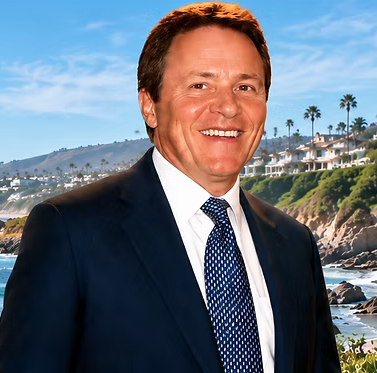
Retired entrepreneur and former Laguna Art Museum trustee whose official statement emphasizes independent leadership, fiscal responsibility, emergency preparedness and environmental stewardship.
Joy Berry
 Joy Berry For City Council Website
Joy Berry November 2026 Official Ballot Statement:
Form 501 Candidate Intention Statement Here
Form 410 Statement of Organization (Coming Soon)
Form 460 Campaign Funding Disclosure Statements:
Form 460 Campaign Funding Statement Jan. 1 – Sept. 19, 2026 here
Media and other Candidate information:
LB Indy – Letters To The Editor
Linkedin
Silver Lining Hospitality Team
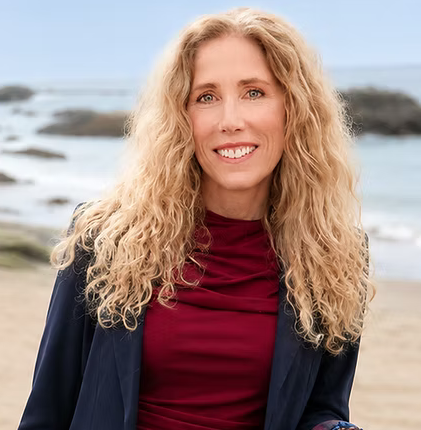
Joy Berry is an official candidate running for the Laguna Beach City Council in the November 3, 2026, General Municipal Election. She filed her candidacy papers on July 31, 2026.
Candidate Background
- Local Experience: Longtime Laguna Beach resident, land-use professional and local hospitality business owner.
- Community Roles: Serves as vice-president of Village Laguna, a local civic preservation organization.
- Key Focuses: Active voice in local land-use, hillside and canyon protection, and city financial stewardship.
Ashley Cintas

Ashley Cintas November 2026 Official Ballot Statement:
Form 501 Candidate Intention Statement Here
Form 410 Statement of Organization (Coming Soon)
Form 460 Campaign Funding Disclosure Statements:
Form 460 Campaign Funding Statement Jan. 1 – Sept. 19, 2026 here
Media and other Candidate information:
Canvas Rebel Magazine – view here
Best of Laguna Substacks Interview – view here
Are We Asking The Righ Questions – Guest Opinion – view here
Candidate Background:
Oto Sushi Laguna LLC is a Limited-Liability Company – CA organized under the laws of the State of California. The business was filed on December 12, 2025 and is currently listed as Active with the California Secretary of State.
The principal office address is located at 370 Glenneyre St Laguna Beach, CA 92651. The Registered Owner is Ashley Cintas.
Another Promenade (& Arts) update, this time for the close of July 2026
It’s time for another Promenade (& Arts) update, this time for the close of July 2026.
Construction progress
A lot more of the brickwork is now complete, allowing us to open another section of the central Promenade closer to Glenneyre. We’ve also placed all of the tables and chairs throughout the site, creating more space for people to sit and enjoy the area. New permanent benches have been installed along the sides of the Coast Highway half of the project. Bricklayers are continuing night work to finish the areas adjacent to the storefronts.
As a reminder, there are two types of decomposed granite, or “DG,” within the interior of the Promenade. Type 1 includes a binder product that helps create a firmer surface. The DG is an important part of the project’s water-quality improvements because it allows more water to percolate through the ground. There is still a significant amount of unbound DG — call it Type 2 — that will be removed in the coming days as storm-drain grates are installed, the custom umbrellas are placed and utility covers are bricked over. As that work continues, conditions will become less dusty, particularly for storefronts currently dealing with DG being tracked inside.
Tree care and monitoring
The City continues to closely monitor the health of the new and existing trees throughout the Promenade. Most are adapting very well, and when a tree shows signs that it needs additional support, the City works with its arborists to provide the appropriate care. A newer eucalyptus (Spathulata) near Coast Highway is currently being monitored because it is showing both healthy new growth and some leaf dieback. The ficus near the ice cream shop will also soon begin a fungus-treatment plan under the guidance of an arborist.
What’s next?
The most active area of construction has shifted to the Glenneyre and Forest Avenue intersection. This is where we’ll see up to four more eucalyptus trees and the signature sycamore, along with the iconic “crazy brick” pattern covering a large area adjacent to the intersection. You’ll also see trenching for IT lines, as well as electrical lines and a new transformer near the Library.
About the “Kelp Forest” water feature
Before I close, I want to address some misinformation surrounding the water feature’s custom “Kelp Forest” installation. Under the project approval, the Arts Commission reviewed the proposed water feature as a potential location for public art. In September 2025, the Commission considered the concept and declined to recommend incorporating public art into the fountain, citing available space, cost and functionality. Following that determination, staff continued working with SWA, the project designer, on the fountain’s custom plinth and top. The specific design now installed was developed during that later phase of the project.
I believe we could have communicated this process more clearly as it occurred, and we have already discussed internally and externally how to do better. In the meantime, arts officials are currently at work identifying precise locations for the three permanent art pieces that will soon return to the Promenade (see below), and the Arts Commission is preparing a call for artists for a robust program of temporary public art on the Promenade.
Laguna’s Commitment to the Arts
This community takes tremendous pride in its reputation as a home for world-class arts and culture. Three important examples of that commitment include:
- Open competitions. Any artist, from anywhere, can compete for our public art opportunities. Laguna Beach artists continue to hold their own alongside artists from across the country and around the world, and inclusion in the City’s broader arts collection is highly prestigious.
- Meaningful arts funding. Approximately $2.25 million each year from the Tourism Marketing District supports arts programs and arts facilities. That investment is further supported by a mandatory art-in-lieu fee, or specific art placement onsite for certain development projects (like Fire Station #4).
- Artist housing and workspaces. Through its partnership with the Community Land Trust, the City has preserved 75 (and counting) artist studios and housing units. These provide safe, affordable spaces that will remain protected from being sold off.
Mark Orgill

Mark Orgill November 2026 Official Ballot Statement:
Form 501 Candidate Intention Statement here
Form 410 Statement of Organization here(Coming Soon)
Form 460 Campaign Funding Disclosure Statements:
Form 460 Campaign Statement Jan. 1 – Sept. 19, 2026 here
Form 460 Campaign Termination Statement Jan. 1 – March 30, 2026 here
Form 460 Campaign Statement Oct. 23, 2022 – Dec. 31, 2022 here
Media and other Candidate information:
Candidate Background:
Sue Kempf

Sue Kempf November 2026 Official Ballot Statement:
Form 501 Candidate Intention Statement here
Form 410 Statement of Organization here(Coming Soon)
Form 460 Campaign Funding Disclosure Statements:
Form 460 Campaign Statement July 1 – Sept. 19, 2026 here
Form 460 Campaign Statement Jan. 1 – June 30, 2026 here
Form 460 Campaign Statement July 1 – Dec. 31, 2025 here
Media and other Candidate information:
Candidate Background:
LB Unified Hit With New Inquiries For Financial Records From ACLU
The action comes after the district recently responded to an OC District Attorney’s inquiry about alleged Brown Act violations.
By Miranda Ceja
Patch Staff
The Laguna Beach Unified School District is facing two more inquiries into board actions, after having to recently respond to a county attorney inquiry about alleged Brown Act violations, The Orange County Register reported.
Local residents have also lodged concerns with the ACLU, which issued the school district its own letter inquiring about possible Brown Act violations regarding response to an April community protest, the report said.
According to the report, the Orange County Board of Education told the district that its Fiscal Crisis and Management Assistance Team is doing an independent review of the district’s financial records.
Nothing Says Summer Like a Fiscal Review
The arrival of FCMAT gives Laguna Beach an opportunity to separate administrative failures, weak controls, and contractual mistakes from much larger allegations of corruption.
By Erika Hennon Rule
Courtesy of A Public Record For Laguna Schools

Laguna Beach Unified is getting another independent review, and I think that is a good thing.
As I have shared before, the employee healthcare contribution issue was serious because public funds were involved, collective bargaining agreements were not followed, and the District paid more for employee benefits than required. The District must understand how it happened, correct it, strengthen controls, and provide the public with an honest accounting of what went wrong.
Now the Orange County Department of Education (OCDE) has asked the Fiscal Crisis and Management Assistance Team (FCMAT) to conduct another formal review in response to requests from members of the Laguna Beach community. LBUSD will be providing the records and information FCMAT requests. OCDE has made it clear that initiating the review does not indicate fraud, misappropriation, or illegal fiscal practices, and that the purpose is to conduct an independent assessment and determine whether the evidence requires reporting under Assembly Bill 139.
The questions now are what FCMAT finds, how the District responds to those findings, and whether Board members who spent months demanding this scrutiny will consistently apply that same respect for public accountability when community members raise documented concerns about the Board itself.
OCDE supports Orange County’s 28 school districts while overseeing state-mandated fiscal matters. It reviews budgets and financial reports, provides operational and legal support, assists with countywide services, and has statutory responsibilities when concerns develop about a district’s financial procedures.
FCMAT operates statewide and was created to help California school agencies identify and resolve financial, operational, and data-management problems. Most of its work is preventive management assistance intended to improve systems before a fiscal crisis develops. At the same time, a smaller portion involves assignments from county and state agencies, including extraordinary audits conducted when there is reason to examine whether fraud, misappropriation, or other illegal fiscal practices have occurred.
The name sounds alarming because it includes “fiscal crisis,” but the organization does more than respond after a district’s finances have failed. FCMAT reviews staffing, contracts, purchasing, internal controls, special education, organizational structure, data management, and other areas where an outside team may identify problems a district has missed or tolerated.
Laguna Beach Unified has worked with FCMAT before.
In September 2017, the District agreed to have FCMAT review LBUSD’s special education program. The Board approved the study unanimously, with staff describing it as voluntary, proactive, and part of continual improvement. Board members clarified that LBUSD requested the assistance and was not facing a fiscal crisis.
FCMAT conducted interviews and reviewed records in January 2018, then issued its final report that May. The study examined general education supports, special education staffing, paraeducators, related-service providers, identification rates, outside placements, organizational structure, due process, and the District’s financial contribution to special education.
The report identified areas for improvement, including student-support processes that varied across school sites; some special education and paraeducator staffing levels exceeding FCMAT standards; inconsistent procedures for assigning certain individualized supports; and an increase in the District’s unrestricted contribution to special education. FCMAT recommended stronger coordination among special education, business services, and human resources. It also suggested a closer review of outside providers and placements, as well as a formal process for resolving parent disputes.
These important findings affected some of the District’s most vulnerable students and involved substantial public resources, complicated legal requirements, and decisions likely to shape a child’s entire school experience. The report did what an outside management review is supposed to do: it examined systems, identified variances and financial pressures, and provided the District with recommendations to improve them.
Sometimes a school district asks FCMAT to help improve a program. In other cases, a county office requests an examination after employees, parents, or community members raise concerns. Sometimes the findings support serious allegations, while at other times a lengthy investigation concludes that the evidence does not establish intentional wrongdoing, even though policies and internal controls still need substantial work.
The current LBUSD review falls into a different category from the 2018 special education study.
OCDE says it initiated this process after receiving requests from members of the Laguna Beach community, and the scope includes employee health-benefit contributions, associated contracting decisions, and the use of District resources. The people who submitted those requests have not been publicly identified.
Howard Hills has spent months pressing substantially the same issues, describing the healthcare contributions in the most alarming terms available to him, questioning the conduct of former District leadership, reviewing potential action by county and state authorities, and arguing the Board should continue pursuing the issue whether the district attorney or another outside agency acts or not.
His public campaign around healthcare has included paid advertisements, communications with outside allies, repeated use of the larger $1.77 million figure, and an email titled “CONFIDENTIAL: Unofficial Communications Management,” where he discussed media coverage, op-eds, full-page advertisements, and the need for someone to coordinate press around District issues, yet somehow he’s calling people he disagrees with “political gossip columnists.”
Given that record, it is reasonable to wonder whether Howard, one or more of his colleagues, or people in his “communications circle” submitted the requests that led to OCDE’s decision. It also matches his stated strategy and the work he has done to extend the healthcare issue beyond LBUSD.
Still, OCDE has not named the requesters, and reasonable suspicion does not turn speculation into fact just because it fits neatly. Until those requests become public, I cannot say Howard submitted them.
I will say he is probably pleased.
He wanted a state or county agency to examine the healthcare issue, and one is now doing that. He has argued the District’s own review and corrective actions were insufficient. FCMAT will request records, examine the underlying processes, and decide whether the evidence supports the level of wrongdoing Howard has repeatedly suggested.
He should celebrate the review if he believes in it, and the District should not treat his satisfaction as a reason to resist the process. Public officials, employees, and community members should be able to request outside scrutiny without being accused of disloyalty merely because the eventual finding may be uncomfortable.
The same principle applies when the request comes from people Howard disagrees with.
Over the last year and a half, community members, employees, and advocacy organizations have signaled concerns about LBUSD’s closed-session practices, agenda control, public-comment procedures, trustee communications, and growing uncertainty about where Board governance ends and District operations begin. Some concerns resulted in formal Brown Act cure-and-correct demands. These allow a public agency to review an alleged open-meeting violation and correct it before the dispute proceeds to litigation. A couple of these demands have been made public, and I know of a few more that have been submitted privately.
A cure-and-correct demand does not prove a Brown Act violation any more than a community request to OCDE proves someone committed financial misconduct. Each begins with an allegation supported by whatever facts, records, and legal arguments the person submitting it believes justify further examination.
The receiving agency is then responsible for fully reviewing the complaint, responding through the appropriate process, and correcting the conduct when warranted.
I think Howard cannot reasonably support community requests that trigger an outside examination of District employees and financial procedures, then dismiss other community complaints as political theater when they ask whether the Board majority followed open-meeting law. He can disagree with the claims, challenge the evidence, and defend the Board’s conduct, but the legitimacy of the process cannot depend on whether he likes those who use it.
The Board’s response to the FCMAT review will tell us a great deal about what its members actually wanted from this process.
Will they allow FCMAT to conduct the review without changing every records request into another public accusation against staff? Will they wait for the findings before announcing what they may prove? Will they accept a conclusion identifying administrative weaknesses without validating Howard’s more extensive narrative of corruption? Will they implement recommendations even when those are technical, procedural, and less dramatic than the story Howard has been selling?
When a complaint involves closed session, trustee communications, or the Board’s use of power, will they show the same patience and respect for the process that they now expect from the employees being reviewed?
Based on several FCMAT reports, Mountain View Whisman School District appears to offer the closest recent comparison to what may happen here.
In 2024, the Santa Clara County Superintendent of Schools requested an AB 139 extraordinary audit after parents, employees, and community members raised concerns about business relationships, contracts, transactions, travel, and reimbursements involving the school district’s former superintendent. FCMAT conducted a broad review of expenditures, internal controls, vendor payments, board approvals, travel, credit card purchases, and reimbursements.
The public debate surrounding that school district became intense, with disputed contracts and spending decisions presented as possible evidence of corruption. After reviewing the transactions, FCMAT concluded it had insufficient evidence to establish fraud, misappropriation, or other illegal fiscal practices. The report still led to improvements in contract procedures, written documentation, credit-card controls, travel policies, and delegated purchasing authority.
Mountain View Whisman shows how an outside review can validate stronger systems without validating every accusation behind it. Community members were entitled to raise questions, the county was entitled to examine them, and FCMAT’s conclusion depended on evidence rather than on the intensity of the public campaign.
Based on the records we have available so far, I think Laguna Beach may end in a similar place.
The healthcare issue showed that agreements were not administered correctly, the District paid more than required, and controls needed strengthening. Michael Bishop & Associates examined spending variances, collective bargaining compliance, and internal controls, while leaving legal impropriety outside its scope.
The District eventually proceeded with a corrective-action figure of about $1.04 million and decided against recovering that money from employees who did not establish the contribution rates or administer the benefit structure. Howard continued to cite the larger $1.77 million figure and framed the issue in terms of staff oversight, unions, and former District leadership.
FCMAT will likely obtain documents the public has not seen, interview people who provide important new information, or identify a contracting problem beyond the contribution calculations already discussed. An independent review has value because the conclusion must remain open until the work is finished.
Even with that possibility, the evidence currently available looks more like an administrative, contractual, and internal-control failure than an intentional scheme to steal public funds or improperly enrich employees. I expect FCMAT will confirm that the contribution process was flawed, identify weaknesses in documentation and oversight, recommend clearer delineation of responsibilities and more frequent reconciliation, and find insufficient evidence to support the larger claims of deliberate fraud or malfeasance.
Howard may say procedural failures proved him right, while others may say the absence of corruption proved him wrong. Both reactions would oversimplify what will likely be a more complicated report.
The healthcare problem required correction, but the evidence has never supported treating teachers and staff as suspects for receiving benefits calculated and administered by the District. Howard was right to ask how the error occurred and how to prevent it. His public campaign against staff, unions, former leadership, and anyone rejecting his framing also remains part of the record.
What happens next will reveal whether Howard and his “colleagues” wanted independent answers or public validation for conclusions they had already reached.
If FCMAT finds misconduct, the District needs to address it directly and publicly. If it identifies weak controls, administrative failures, or poor documentation, the District should implement the recommendations and explain the changes. If FCMAT finds insufficient evidence of fraud or malfeasance, the Board owes the public the same clarity and should not stretch procedural failures into unsupported allegations.
The Board should remember the standard it helped establish. OCDE took community financial concerns seriously, and FCMAT will examine the records before reaching a conclusion. Documented concerns about closed sessions, trustee communications, agenda control, and the Board’s use of power deserve the same review and respect for evidence, even when those under scrutiny sit on the dais rather than work in the District office.
Howard has spent months insisting that outside scrutiny is necessary when the allegations involve employees, unions, and former District leadership. He cannot reasonably celebrate that process while dismissing cure-and-correct demands and other governance complaints as meaningless simply because they involve his own Board majority.
The community should pay close attention to what FCMAT finds, but the Board’s response may tell us even more. Howard wanted someone outside LBUSD to look closely at what was happening inside the District, and now that review is here. The harder test will be whether his circle still believes in transparency when the call for accountability comes from inside the house.